REVIEW · MEXICO CITY MURAL TOURS
Mexico City: History on Walls. Mexican Murals Walking Tour
Walls can explain a nation. This four-hour Mexico City tour makes that idea its starting point, using murals by Diego Rivera, José Clemente Orozco, David Alfaro Siqueiros, and other artists to explain Mexico’s politics, culture, and Mesoamerican past. I especially like the expert art-history guide and the chance to see murals in several very different settings, from the grand Bellas Artes Palace to a working market. The small group, limited to 10 people, should also make it easier to hear and ask questions.
The main drawback is the price: $218 per person is a serious investment for a walking tour. You also need comfortable mobility for four hours on foot, and the final part of the route can vary between a Diego Rivera-focused stop and a former high school filled with Orozco murals. Still, for someone who wants context rather than a quick look at famous paintings, this is a strong, specialized choice.
Key points at a glance
- Bellas Artes sets the stage: See major works by Rivera, Siqueiros, and Orozco inside Mexico City’s famous Fine Arts Palace.
- Murals tell political stories: Learn how the post-Revolution government used public art to educate people and shape a national identity.
- The route goes beyond famous names: Tamayo, González Camarena, and Rodríguez Lozano add different voices to the story.
- A market becomes an art site: Murals from the 1930s survive in a public market, showing how art was taken outside elite institutions.
- A rooftop coffee break slows the pace: Rest your feet while looking over the Historic District.
- The final stop may differ: You may focus on Rivera’s scenes of work and festivals, or visit an old school where Orozco criticized Mexico’s social classes.
Why Mexico’s murals matter
Mexico’s mural movement grew during the 1920s and 1930s, after the Mexican Revolution. The country was trying to define itself, educate a population, and present a shared national story. Murals offered a powerful solution: they were large, public, and free to view.
Many people could not visit a museum or buy a painting. A wall in a government building, school, market, or palace reached them where they lived and worked. The art carried political ideas, scenes from everyday labor, Indigenous and Mesoamerican references, and criticism of social inequality.
That context is the real reason to take this tour. Without it, a mural can become a grand wall covered with crowded figures. With a guide explaining who is shown, what the symbols mean, and why the work was commissioned, the paintings become arguments about Mexico itself.
I would not choose this experience if you only want a quick introduction to Mexico City’s main sights. I would choose it if you like art with a political edge, large historical stories, and the chance to compare different artists in the places where their work was intended to be seen.
More Street Art Walking Tours in Mexico
- History and Murals: Walking Tour Guadalajara
★ 5.0 · 237 reviews - Walking Tour – Impressive murals in Historical Center of Mexico City
★ 5.0 · 224 reviews - Muralist Art Semi Private Walking Tour in Mexico City Downtown
★ 5.0 · 188 reviews
Starting at Bellas Artes with Rivera, Orozco, and Siqueiros
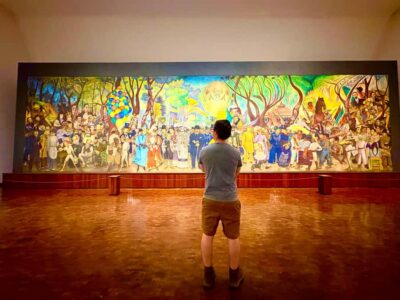
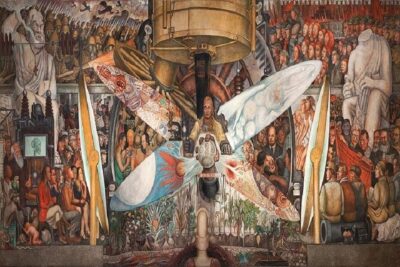
The meeting point is in front of the main entrance to the Bellas Artes Palace. This is a practical place to begin because the building gives the tour an immediate sense of scale and ceremony. Your guide starts with murals by Mexico’s three best-known muralists: Diego Rivera, José Clemente Orozco, and David Alfaro Siqueiros.
Seeing these artists together helps you compare their approaches. Rivera is often associated with detailed scenes of workers, national traditions, and historical change. Orozco’s work can feel more critical and troubled, while Siqueiros pushed toward forceful political expression and dramatic movement.
The point is not simply to check three famous names off a list. You will look at how each artist treated bodies, crowds, power, labor, and the country’s past. The guide also introduces Rufino Tamayo, González Camarena, and Rodríguez Lozano, giving you a wider view of Mexican art than the standard Rivera-only introduction.
Bellas Artes is a major indoor stop, but you should still wear comfortable shoes. The tour continues on foot, and the four-hour schedule includes outdoor walking. A hat and sunscreen are sensible because the route takes place rain or shine.
A former colonial palace and the grief of war
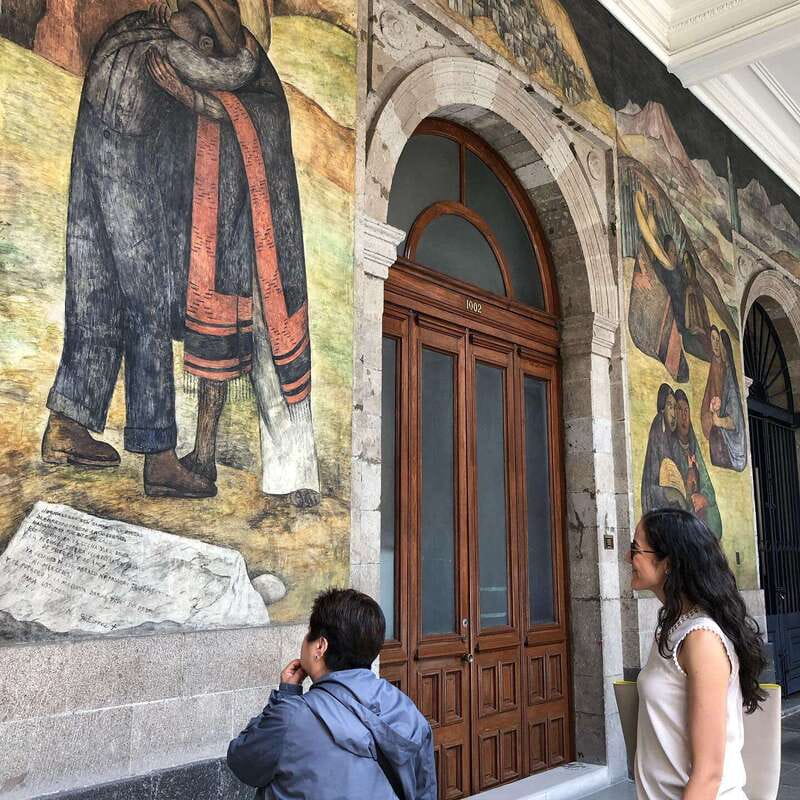
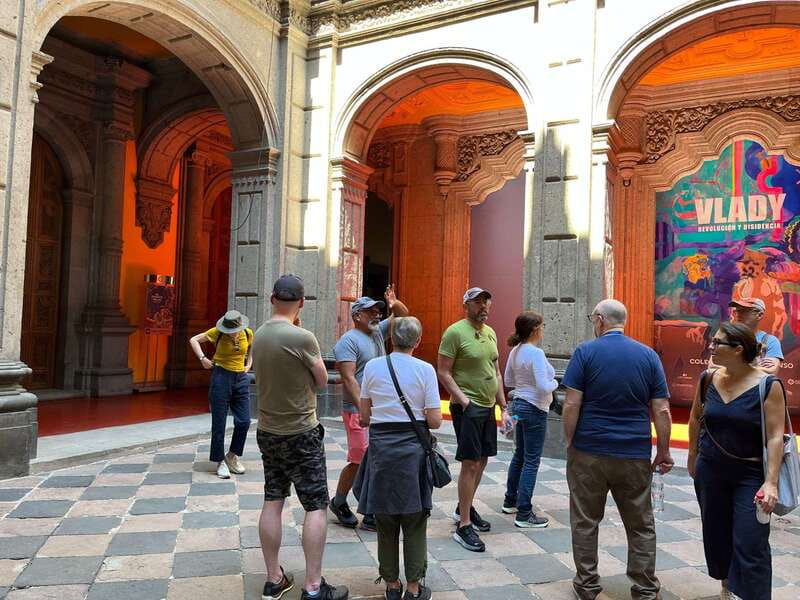
One of the more unusual parts of the route brings you to a mural in a former colonial palace. The work expresses the grief of the Holocaust and connects Mexican mural art with the Second World War.
This stop matters because it broadens the tour beyond Mexico’s Revolution and national identity. Mexican murals were not limited to local subjects. They could also respond to international suffering and place Mexico within a much larger twentieth-century story.
The setting adds weight. A colonial palace carries the marks of an earlier era, while the mural confronts one of the modern world’s darkest events. That contrast gives you another way to think about public art: a historic building can become a place for mourning, warning, and moral reflection.
The supplied details do not identify the artist or the exact palace, so you should expect the guide to provide that information on the day. The important point is the theme and setting, not a promise of a particular artist’s work.
Coffee above the Historic District
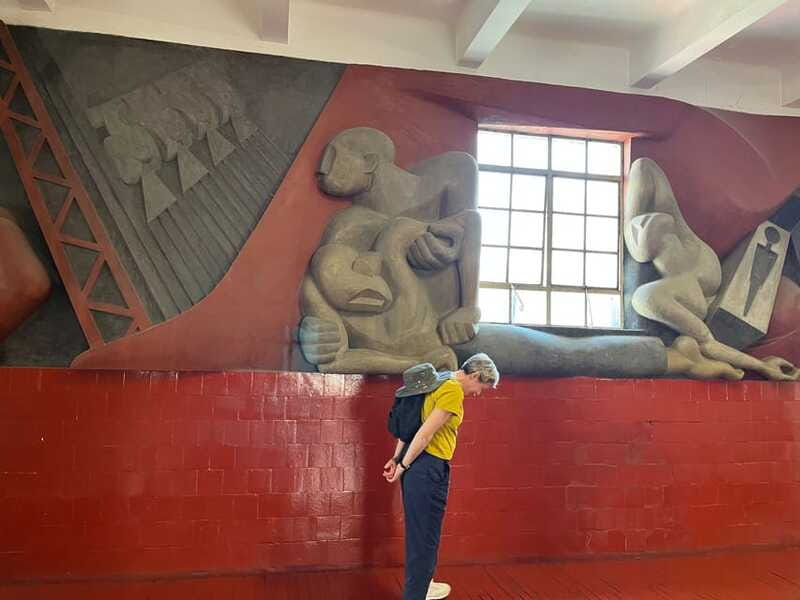
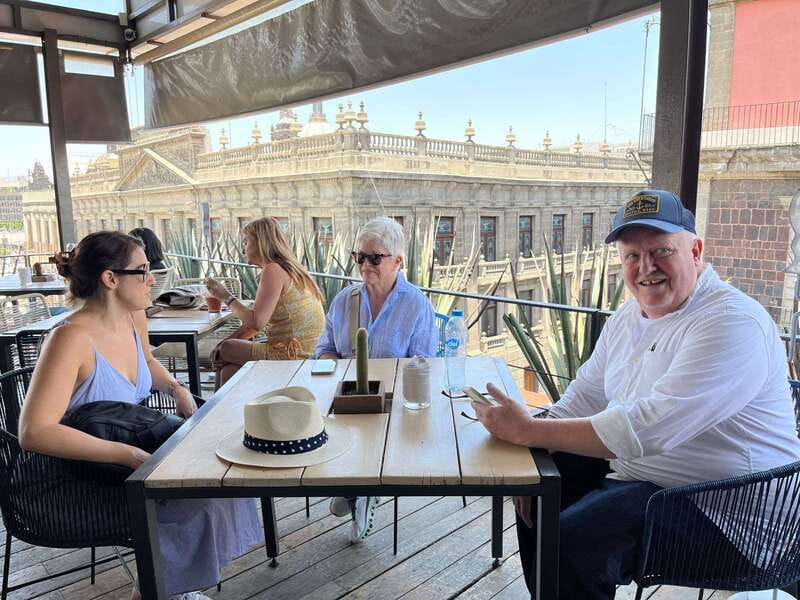
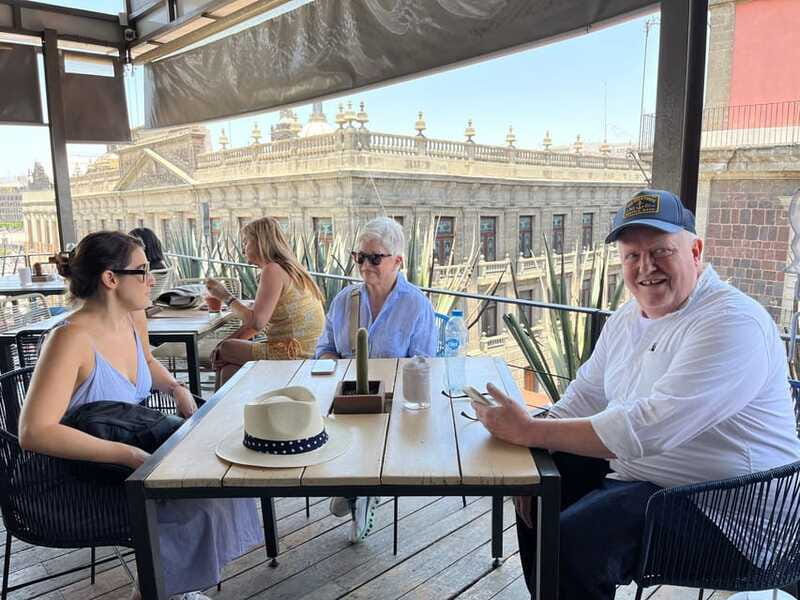
After several art stops, you take a break from walking and the sun with a cup of coffee at a rooftop location overlooking the Historic District. This is a small part of the itinerary, but it serves a useful purpose.
Murals demand concentration. You may spend several minutes looking at a crowded wall, following a figure across the composition, or listening to political and historical details. A seated pause gives your eyes and feet a rest before the next stop.
The view also changes how you see the city. Instead of examining one wall at close range, you look across the Historic District as a whole. The coffee and food arrangements are not included, so the included cup of coffee is the stated refreshment. You should not count on a full meal during the tour.
This break is especially helpful on a sunny day. Even though the tour is only four hours, walking between indoor and outdoor sites can feel tiring, particularly if you are not used to Mexico City’s altitude or busy streets. The route is not suitable for people with mobility impairments, and anyone with limited stamina should consider that carefully.
More Street Art Walking Tours in Mexico City
- Mexico City: Diego Rivera’s Murals Guided Walking Tour
★ 5.0 · 49 reviews - Guided Walking Tour Describing UNAM Murals and Revolution
★ 5.0 · 8 reviews - Mexico City: Historic Center Walking Tour with Murals
★ 5.0 · 6 reviews - Mexico City: The Murals of Mexico Semiprivate Walking Tour
★ 5.0 · 2 reviews
Murals inside a public market
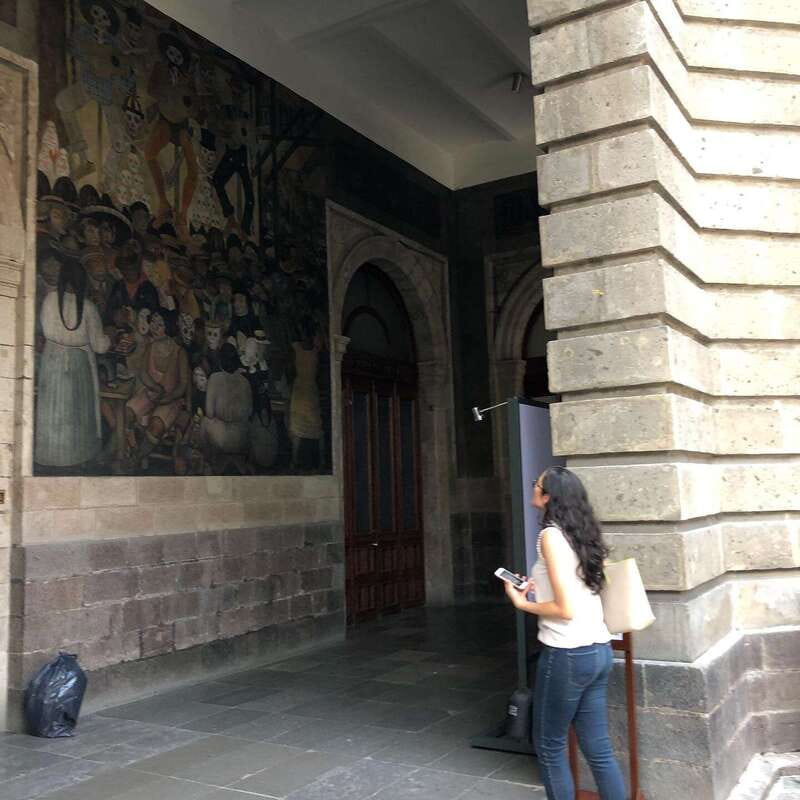
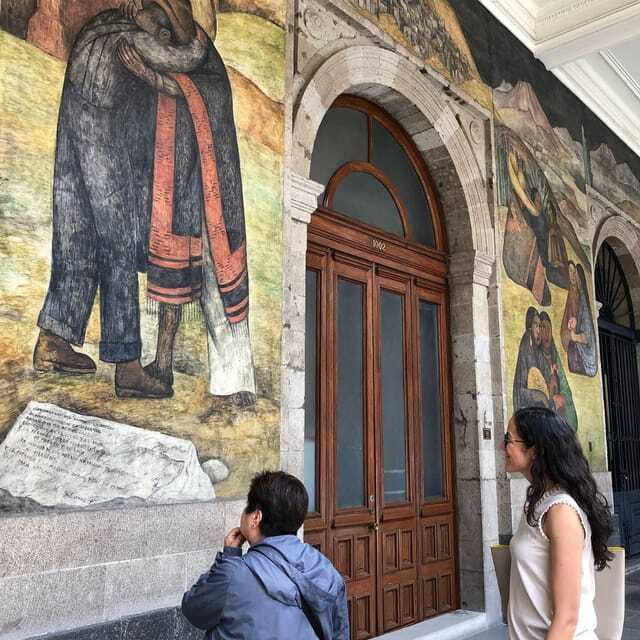
The tour then visits 1930s murals preserved inside a market. This is one of the most appealing ideas in the program because it shows how the mural project reached ordinary people.
A palace or formal museum can make art feel separate from daily life. A market does the opposite. People come to shop, work, and move through the building, while the murals remain part of that public setting. The location reflects the belief that education and culture should not belong only to wealthy districts or private collections.
You will see work by Mexican and foreign artists connected to this effort. The guide explains how the government and artists used public buildings to spread ideas and teach history. This is also a useful reminder that the mural movement was not just a collection of individual masterpieces. It was a broader cultural program.
Expect a less polished viewing environment than a conventional gallery. A market is a working public place, not a quiet exhibition hall. That is precisely what gives the stop its character, but it may not suit someone who wants perfect lighting, silence, and an uninterrupted view of every painting.
Choosing between Rivera’s national scenes and Orozco’s sharp criticism
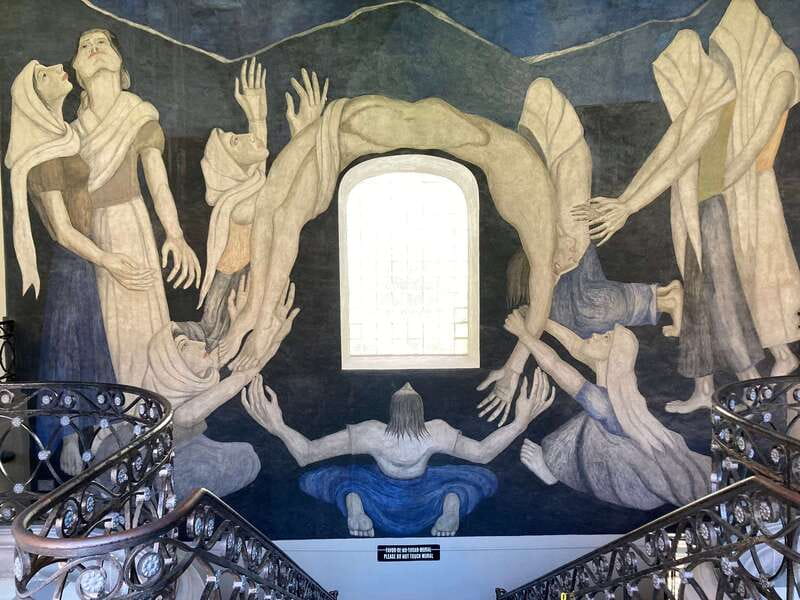
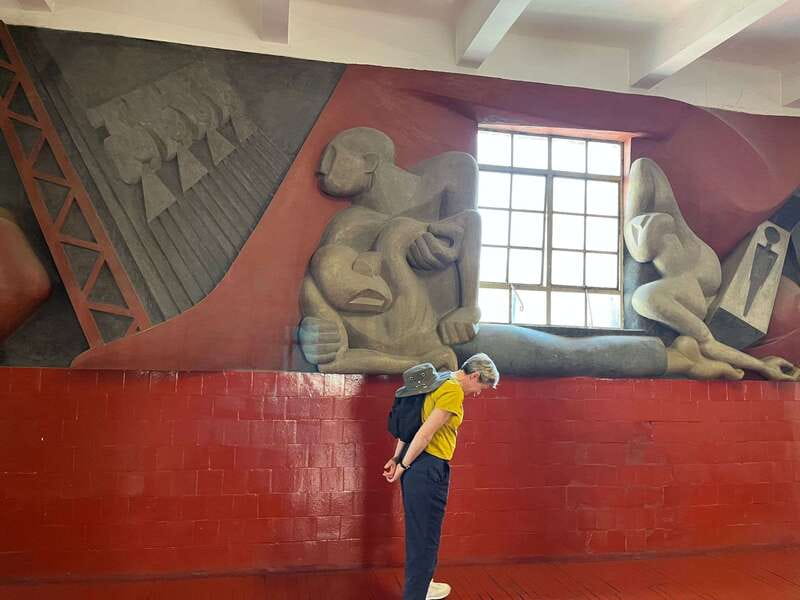
The final portion can follow one of two paths. One option centers on Diego Rivera murals from the 1920s that show different kinds of work and festivals from across Mexico. The other returns to post-Revolutionary Mexico through a former high school where Orozco criticized the country’s social classes.
The Rivera route focuses on variety. His scenes of labor and celebration present Mexico as a country of many regions, occupations, customs, and traditions. You can expect the guide to help you read the mural as a large national portrait rather than a simple collection of colorful scenes.
The Orozco route is more confrontational. A former high school becomes the setting for murals that question Mexico’s social divisions in the 1920s. The subject fits Orozco’s tendency toward criticism and makes the building itself part of the story. You are not just looking at a painting about education and class. You are standing in a place associated with education while seeing its social promises challenged.
Since the details describe these as alternatives, confirm with the guide which route is scheduled. If one artist matters especially to you, ask about the day’s plan before the walk begins. This is one of the few points where the experience may not be identical for every departure.
What the guide adds
The tour includes a guide with a graduate academic degree in art history, history, or architecture. That qualification matters here because the subject is not just visual style. You are dealing with the Mexican Revolution, post-Revolutionary politics, Mesoamerican culture, colonial buildings, the Holocaust, education, social class, and public art.
A good guide can prevent the tour from becoming a string of dates and artist names. You want help noticing how a mural is organized, why particular people appear, and how the message changes depending on the building. The stated tour languages are English and Spanish, so choose the language in which you can comfortably follow a long explanation.
The group is limited to 10 people, which is a real advantage at crowded cultural sites. You should have a better chance of staying near the guide and asking questions than you would in a large coach group. Headsets are provided for large groups, although this experience is advertised as a small group, so the need for them may vary.
Is $218 a fair price?
At $218 per person, this is not a budget walking tour. The price makes sense only if you place high value on expert interpretation, museum admission, and a carefully connected art itinerary.
You are paying for four hours, a graduate-level guide, museum tickets, several mural locations, and a small group. The tour also saves you the work of researching which murals matter and how to reach them. For an art-focused visitor, that can be worthwhile, especially in a city where major works are spread across different buildings and neighborhoods.
Still, the price is difficult to justify if you mainly want to see Bellas Artes. You could spend less by visiting one museum on your own, though you would lose the guide’s explanations and the wider route through markets, historic buildings, and public spaces.
I would book this for a visitor who wants a focused art seminar with walking built in. I would skip it if your budget is tight, if you prefer independent sightseeing, or if you want a broad Mexico City tour covering food, neighborhoods, and general attractions.
Practical details for a smoother walk
Meet your guide in front of the main entrance to the Bellas Artes Palace. Hotel pickup and drop-off are not included, so arrange your own way to the starting point and from the end of the route.
Wear shoes you can walk in for four hours. Bring a hat and sunscreen, and plan for changing weather because the tour operates rain or shine. Food and drinks are not included, apart from the stated coffee break, so eat beforehand if you need a proper meal.
Free cancellation is available up to 24 hours before the start for a full refund. You can also reserve now and pay later, which helps if your Mexico City plans are still shifting.
Who should book this mural walk?
I recommend it most strongly to art lovers, history students, architecture fans, and first-time visitors who want to understand why Mexico City’s murals are more than decoration. It also suits people who enjoy seeing art in public settings rather than only behind museum doors.
The tour is less suitable for anyone with mobility impairments, anyone who dislikes long explanations, or anyone seeking a relaxed café-and-sightseeing outing. Four hours is enough time to build a clear story, but it is also long enough for the walking and standing to matter.
Should you book Mexico City: History on Walls?
Book it if Rivera, Orozco, Siqueiros, and the politics of public art sound more interesting than a standard city tour. The mix of Bellas Artes, a former colonial palace, a rooftop view, a market, and either a Rivera or Orozco finale gives the experience real range.
Think carefully about the cost and walking demands. At $218, this needs to be a priority experience, not an impulse booking. For the right visitor, the expert guide and access to murals in everyday settings can turn a day of looking at walls into a clear lesson about Mexico’s modern identity.
FAQ
How long is the Mexican murals walking tour?
The tour lasts four hours.
Where does the tour meet?
Your guide waits in front of the main entrance of the Bellas Artes Palace.
What languages are available?
The tour is available in English and Spanish.
How many people are in the group?
The group is limited to 10 participants.
Are museum tickets included?
Yes. Museum tickets are included in the tour price.
Is a guide included?
Yes. The tour includes a live guide with a graduate academic degree in art history, history, or architecture.
Are hotel pickup and drop-off included?
No. You need to make your own way to the Bellas Artes meeting point and arrange transportation afterward.
Are food and drinks included?
Food and drinks are not included. The itinerary includes a coffee break, but no meal is provided.
What should I bring?
Bring comfortable shoes, a hat, and sunscreen.
Does the tour operate in bad weather?
Yes. The tour takes place rain or shine.
Can I cancel for a full refund?
Yes. You can cancel up to 24 hours in advance for a full refund.
Is the tour suitable for people with mobility impairments?
No. The tour is not suitable for people with mobility impairments.
More History Tours in Mexico
- Private Walking Tour Guadalajara History and Murals with Guide
★ 5.0 · 6 reviews - Tour history of Muralism in Mexico
★ 5.0 · 5 reviews - Street Art & Cemetery Cultural Tour – half day
★ 5.0 · 3 reviews - Historic tour in the center and murals of Orozco
★ 5.0 · 2 reviews
Just added around Mexico
- Xochimilco floating gardens, Coyoacan and UNAM murals★ 4.0 · 6 reviews
- UNAM: Murals & Revolution★ 4.9 · 8 reviews
- Street Art & Cemetery Cultural Tour – half day★ 5.0 · 3 reviews
- Graffitis & Munchies biketour Playa del Carmen★ 4.5 · 18 reviews
- Street Art Walk★ 4.5 · 7 reviews
- Tour Women Muralists : Strokes that resist Mexico City★ 5.0 · 7 reviews
- Diego Rivera’s murals, hidden treasures★ 5.0 · 21 reviews
- Mexico City Private Tour with Teotihuacan, Murals, Guadalupe Basilica★ 3.0 · 2 reviews
Mexico City Mural Tours, compared.
Xochimilco, Coyoacan, Frida Kahlo Museum & Murals Tour
Read our review →
Walking Tour – Impressive murals in Historical Center of Mexico City
Read our review →
La Catrina & Muralism: Diego Rivera’s Legacy & Frida Kahlo
Read our review →
Muralist Art Semi Private Walking Tour in Mexico City Downtown
Read our review →
Xochimilco floating gardens, Coyoacan and UNAM murals
Read our review →