
REVIEW · MADRID MURAL TOURS
Madrid: Street Art Bike Tour
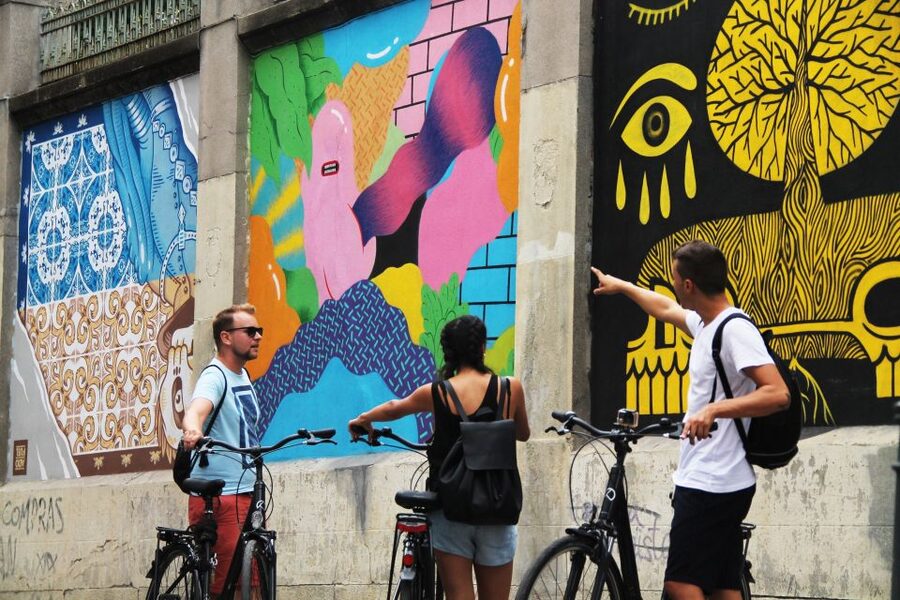
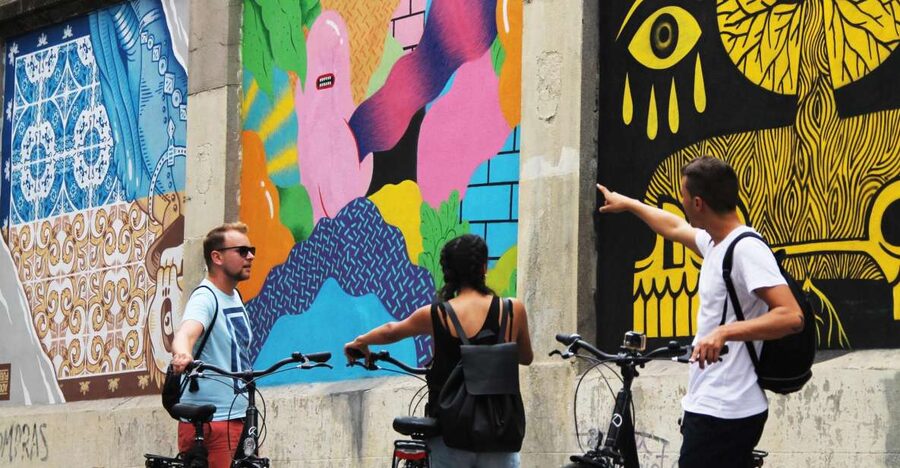
Madrid’s walls tell lively stories. This 2.5-hour bike tour takes you through Malasaña and Lavapiés with a local graffiti artist, connecting major festival pieces with neighborhood projects, old tags, and community art spaces. It offers more than a quick look at painted walls: you learn how street artists work on shutters, walls, traffic posts, and other parts of the city.
I especially like the chance to see Muelle’s preserved 1989 tag, an important early mark in Madrid’s graffiti movement, and the visit to Esto es una Plaza, a former abandoned site turned into a community garden. The price, $46 per person, is fair for a guided ride that includes a bike, helmet, lock, map, and a guide who can explain the work from an artist’s point of view.
The main consideration is cycling ability. Madrid traffic, city streets, and one uphill section can make this a poor match for anyone who is not comfortable riding in an urban setting. The activity is described once as 2.5 hours and once as 3 hours, so allow roughly half a day rather than planning a tight connection afterward.
Key Points At A Glance
- Muelle’s 1989 tag: See one of the oldest preserved signs of Madrid’s graffiti movement.
- Malasaña festival art: Ride through the streets around Plaza Dos de Mayo and see work from Pinta Malasaña.
- A local artist as guide: Learn about graffiti methods and Madrid’s street art scene from someone who works in the field.
- Two community art spaces: Visit Solar Antonio Grilo and Esto es una Plaza, both linked to local neighborhood projects.
- Madrid’s biggest central mural: The route includes a chance to see the largest mural in the Center District.
- Medium-level cycling: The route has city traffic and one uphill section, so basic confidence on a bike matters.
Why This Tour Works For Street Art Fans
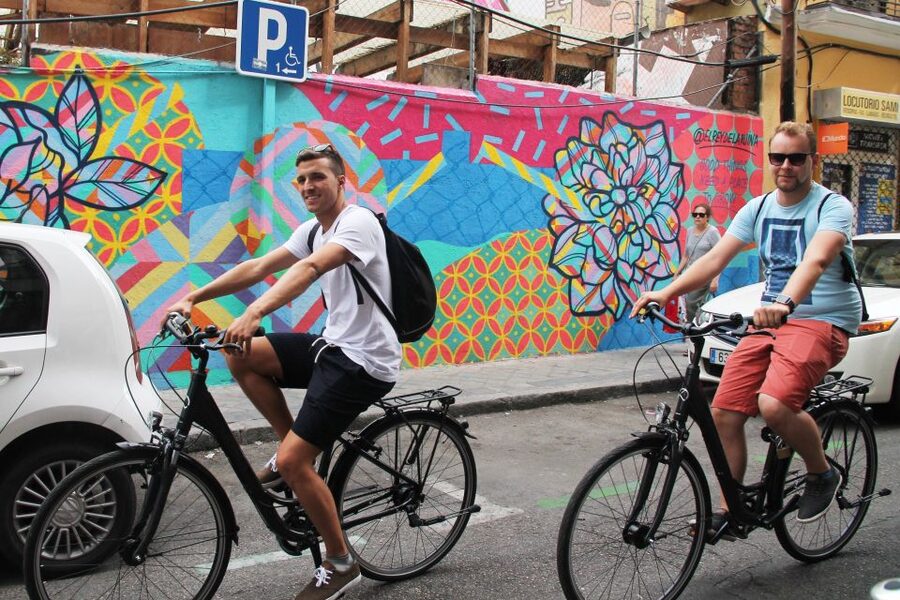
Madrid’s street art is not confined to one gallery or a single painted alley. It appears on metal shop shutters, traffic barriers, blank walls, old buildings, and community spaces. That makes a bicycle tour a sensible way to see it. You can cover more ground than on foot while still slowing down for the pieces that deserve a closer look.
The guide’s background is a major part of the experience. A local graffiti artist can explain the practical side of the work: how artists use different surfaces, how a tag differs from a larger mural, and why certain walls or urban spaces become gathering points for artists. You are not simply being shown a list of colorful photographs. You are given a way to read the city’s marks.
I also like the route’s balance between well-known artists and neighborhood work. You see pieces connected with national and international festival projects, but you also visit community-led spaces where art is part of everyday local life. That mix gives the tour more substance than a quick hunt for Instagram backdrops.
The experience has a 4.5 out of 5 rating from 21 ratings, and the strongest praise centers on the guide, the street art explanations, and the chance to see less obvious parts of Madrid. One family had a private outing with Javier and found the route suitable for children from age seven who could ride their own bikes. Another participant praised the art instruction but noted that less confident cyclists found Madrid traffic and the uphill sections challenging.
More Street Art Bike Tours in Spain
- Barcelona Street Art and Graffitti Bicycle Tour
★ 5.0 · 361 reviews - Valencia: Street Art Tour on Bicycle, E-Bike or E-Step
★ 4.8 · 31 reviews - Bilbao: Street Art Small Group E-Bike Tour
★ 4.8 · 23 reviews
Starting At Montera 32
The tour begins outside the small Carrefour Express at C/Montera 32. This is close to both Gran Vía and Sol metro stations, so the starting point is easy to reach from many parts of central Madrid.
Arrive ready to ride rather than treating the meeting point as a place to get organized. Comfortable shoes are recommended, and you should bring a passport or ID card. The bike, helmet, lock, and Madrid city map are included, along with a live guide in English or Spanish.
The tour ends back at the same meeting point. That is useful if you want to continue sightseeing in central Madrid afterward, but remember that you will be returning by bike. Do not plan a formal meal or timed attraction immediately afterward unless you leave extra room in your schedule.
Before setting off, the guide explains bicycle safety. This is important because the route uses city streets rather than a completely protected cycling path. If you are comfortable riding in traffic, the city setting becomes part of the fun. If you only ride on quiet trails, this may feel demanding.
Muelle And Madrid’s Early Graffiti Movement
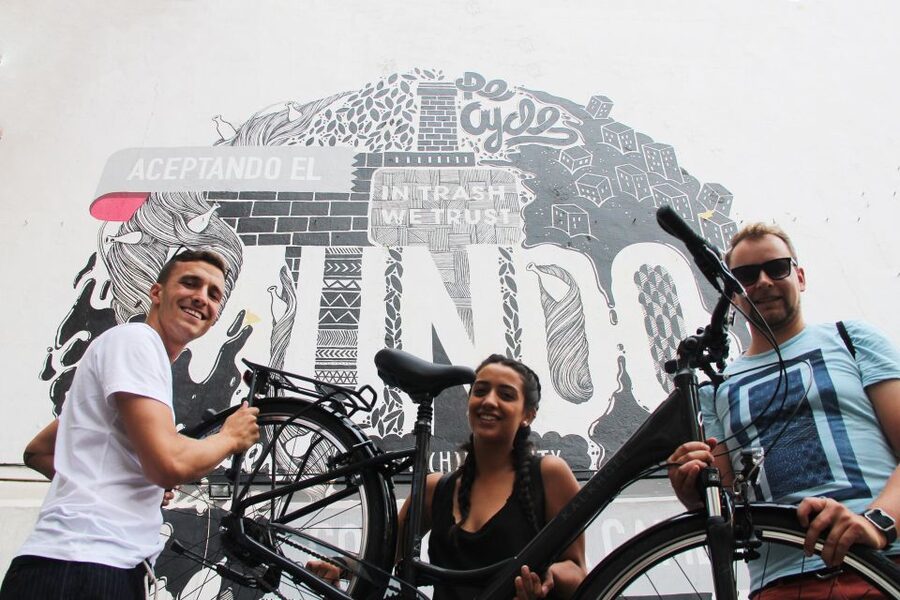
The first historical stop focuses on Muelle, considered a pioneer of Madrid’s graffiti movement. You will see a tag preserved from 1989, linked to a very young artist who helped establish a new cultural movement in the city.
This is one of the tour’s most useful stops because it places today’s murals in a longer timeline. Large festival walls can seem like a recent trend, but Madrid’s graffiti culture has older roots. Muelle’s mark shows how a simple signature could become part of a city’s cultural memory.
The stop also helps you understand the difference between a tag and a large mural. A tag is often quick, personal, and tightly tied to the artist’s identity. A mural takes more planning and space. Seeing both during the same route gives the guide a natural way to explain how street art changed over time.
Do not expect a traditional museum display with labels and lighting. The value is in standing in the street, looking at a preserved mark in its original urban setting, and hearing why it matters.
Alonso Martínez And Boa Mistura
After the safety briefing and opening history, the group rides toward Alonso Martínez. Here you see the first piece created by Boa Mistura, a Madrid crew that grew up on the city’s outskirts and later worked on street art projects around the world.
The stop adds a local angle to a group with an international reach. Boa Mistura is also regarded as one of Spain’s important design agencies, so the guide can connect street painting with graphic design and public art. That gives you another useful distinction: some artists work mainly through spontaneous tags, while others develop carefully designed pieces for public spaces and organized projects.
The first work by Boa Mistura is especially useful as a starting point because it shows the group’s roots in Madrid. You are not only looking at a famous name. You are seeing where that creative story began.
Since the tour includes a Madrid city map, you can mark locations that interest you as you ride. The map is a small inclusion, but it helps if you want to revisit a neighborhood later on foot.
Same walls, a different guide:
- Madrid: Street Art Tour with Local Graffiti Hunter
★ 4.8 · 270 reviews - Street Art Guided Tour in Madrid
★ 5.0 · 175 reviews - Barcelona Street Art Tour with Exclusive Artist Studios Visit
★ 5.0 · 152 reviews - Raval Street Art and Graffiti Guided Tour in Barcelona
★ 5.0 · 81 reviews
Malasaña And The Pinta Malasaña Festival
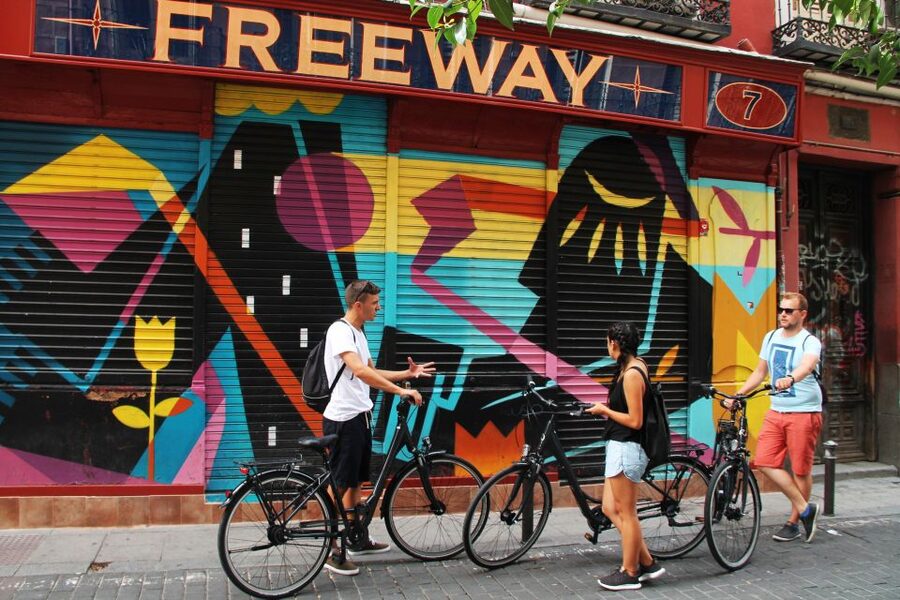
The route then heads toward Malasaña, one of Madrid’s trendiest central neighborhoods. The area is closely linked with the Pinta Malasaña street art festival, which colors the neighborhood during April.
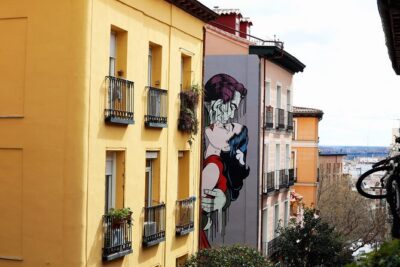
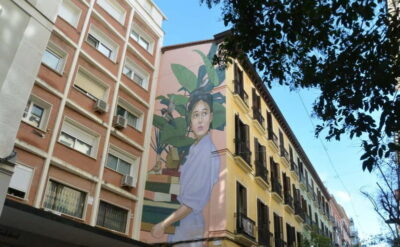
The festival’s work is one of the route’s strongest draws. You see pieces by national artists who took part in the 2017 edition, allowing the guide to explain how a neighborhood-wide event can change the appearance of ordinary streets. The art is not isolated in one official gallery. It appears among shops, apartment buildings, street furniture, and daily city traffic.
Plaza Dos de Mayo is the center of this section. Here you encounter Bolardo Voy, Bolardo Vengo, a playful, colorful treatment of traffic posts. It is a good example of how street art can transform objects that most people ignore. A traffic barrier becomes part of the visual character of the neighborhood.
Malasaña is also a practical place to notice the difference between a festival piece and an unsanctioned tag. Some works are planned and organized, while others may appear quickly and disappear just as fast. The guide’s experience should help explain that difference without reducing the scene to a simple good-versus-bad argument.
The drawback is that the route can be harder for cyclists here. Central Madrid streets may be busy, and your attention will be split between traffic, the group, and the artwork. Listen carefully to the safety instructions and keep your eyes on the road while moving. The best photographs can wait until the group stops.
Solar Antonio Grilo And Community-Made Space
The tour also visits Solar Antonio Grilo, a local urban garden and art space linked with the Noviciado area. It was once an abandoned site and is now used as a community project.
This stop gives the route a change of pace. Instead of focusing only on artists with recognizable names, you see how residents can reclaim neglected urban space. The art is part of a larger idea involving gardening, community use, and local organization.
The tour describes these sites as examples of hybrid economy systems, meaning they combine community activity with practical local use. You do not need a background in urban planning to appreciate the result. The basic lesson is clear: an empty place can become useful when local people organize around it.
For you, this stop is valuable because it shows a side of Madrid that a standard monument tour often misses. It also makes the street art feel connected to people who live in the neighborhood rather than treating it only as decoration.
Esto Es Una Plaza In Lavapiés
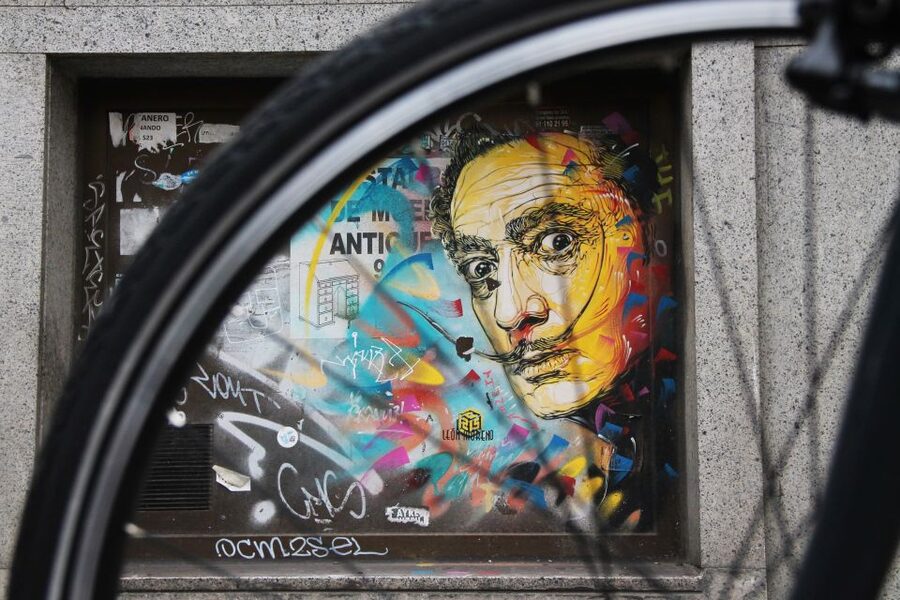
The route continues into Lavapiés and stops at Esto es una Plaza. Like Solar Antonio Grilo, it began as an abandoned place and became a community garden filled with urban art.
Lavapiés is a good neighborhood for this kind of tour because the art sits within a varied, lived-in part of the city. Here, you see how painted walls and shared public areas can work together. The space is not simply a backdrop for murals. It is an example of residents creating a place for local use.
The route includes work associated with artists such as El Rey de la Ruina, Cassassola, Ze Carrión, and Por Favor. The guide can point out how their approaches differ, from large painted images to lettering and more graphic forms.
I consider this one of the tour’s most meaningful sections. The large festival works in Malasaña are visually striking, but the community gardens explain why public art matters beyond appearance. You see art linked with neighborhood identity, local effort, and the reuse of neglected spaces.
The Largest Mural In Madrid’s Center District
The experience also includes a chance to see the biggest mural in Madrid’s Center District. The available details do not identify the exact artist or give the mural’s dimensions, so you should treat this as a major route highlight rather than a separately described attraction.
It is likely to be one of the tour’s best photo stops, but the larger value is seeing how scale changes the way art interacts with a city. A huge wall can alter your sense of a street in a way a small tag cannot. The guide can also place it beside the smaller, more personal marks seen earlier in the ride.
Because the tour covers several districts, not every stop will receive the same amount of time. The focus is on seeing a range of work and understanding its setting, not spending a long period at one mural.
Cycling Difficulty, Family Suitability, And Comfort
The activity is described as medium level and includes one uphill section. A participant in a group with several below-average cyclists found that city traffic and uphill routes made the ride more challenging, although the guide adjusted the tour as much as possible.
That is useful practical information. You do not need to be a serious cyclist, but you should be comfortable controlling a bike on city streets. You also need to manage starts, stops, turns, and group riding without becoming stressed.
The tour can work for families. Javier guided one family with a seven-year-old riding independently, and the outing was described as smooth and enjoyable. Still, age alone does not determine suitability. A child should be confident on a bike, able to follow safety directions, and ready for a ride through central Madrid.
Wear comfortable shoes and clothing that allows easy movement. The tour includes a restroom break, but beverages are not included, so plan for your own drink. The bicycle, helmet, lock, and map are provided.
Is $46 A Fair Price?
At $46 per person, the tour offers reasonable value if you want more than a self-guided ride. You are paying for the bicycle and safety equipment, but the main value comes from the guide’s interpretation of Madrid’s graffiti culture and the route through several neighborhoods.
A cheaper bike rental would not provide the same context. You might find the murals on your own, but you would need to research Muelle, Boa Mistura, Pinta Malasaña, and the community gardens separately. You would also spend time locating pieces that can be easy to miss from the street.
The price is less compelling if you already know Madrid’s street art scene or prefer to move at your own pace. The tour follows a set route, and the group must keep moving between stops. For a first visit, though, the mix of historical context, festival art, community spaces, and local guidance makes the cost sensible.
Free cancellation is available up to 24 hours before the activity, and you can reserve now and pay later. Those options are useful if your Madrid schedule is still changing.
Who Should Book This Bike Tour?
I would recommend this experience to anyone who enjoys public art, urban neighborhoods, and guided sightseeing with a local angle. It suits visitors who want to see Malasaña and Lavapiés in a more focused way than a general city tour allows.
It is also a good choice if you want a break from churches, museums, and royal buildings. Madrid has plenty of formal attractions, but this ride shows how residents and artists have shaped the city’s everyday streets.
Families can consider it if children already ride confidently. English and Spanish are available, and the guide can adjust the route when needed, but the city traffic still makes basic cycling ability important.
I would skip it if you dislike riding in traffic, struggle with hills, or want a slow walking tour with long stops. The activity is active and practical. You will spend much of the time moving, so the ride itself is part of the experience.
FAQ
How long does the Madrid Street Art Bike Tour last?
The activity is listed as 2.5 hours, while the important information also describes it as a 3-hour medium-level activity. Allow roughly three hours.
What languages are available?
The live guide is available in English or Spanish.
Where does the tour start?
It starts at the entrance of the small Carrefour Express at C/Montera 32, near Gran Vía and Sol metro stations.
Where does the tour end?
The tour ends back at the same meeting point on C/Montera 32.
Is a bicycle included?
Yes. The bicycle rental is included, along with a helmet and lock.
Is the tour suitable for children?
It can suit children who are confident cyclists. One family completed the ride with a seven-year-old on their own bike, but the route includes city traffic and one uphill section.
Do I need to bring identification?
Yes. You should bring a passport or ID card.
Are drinks included?
No. Beverages are not included. A restroom break is included.
Can I cancel the tour for a refund?
Yes. You can cancel up to 24 hours in advance for a full refund. You can also reserve the activity and pay later.
Should You Book It?
Book this tour if you want Madrid’s street art explained by someone connected to the scene, not just photographed from a passing bus. Muelle’s preserved tag, Boa Mistura’s early work, the Pinta Malasaña pieces, and the community gardens in Lavapiés give the ride a strong range.
The deciding factor is your comfort on a bike. If you can handle central-city riding and one uphill section, $46 buys a useful three-hour introduction to Madrid’s creative neighborhoods. If traffic makes you uneasy, choose a walking experience instead.
More Bike Tours in Spain
- Barcelona: 3.5-Hour Street Art Tour by Bamboo Bike
★ 5.0 · 56 reviews - Valencia Street Art | Private Tour by Bike or Electric Ride
★ 5.0 · 22 reviews - Valencia Street Art | Small Group Guided Tour by Bike
★ 5.0 · 16 reviews - Mexico City; ART NACO : Murals & Street Art Bike Tour
★ 5.0 · 284 reviews
Just added around Spain
- Small-Group Graffiti Tour and Workshop in El Carmen★ 5.0 · 2 reviews
- Bilbao Urban and Street Art Walking Tour★ 5.0 · 2 reviews
- Barcelona Street Art, Graffiti and Tapas Tour★ 4.0 · 5 reviews
- Salamanca: Private Guided Street Art Walking Tour★ 5.0 · 2 reviews
- Private Barcelona Street Art Tour★ 5.0 · 2 reviews
- Barcelona | StreetArt Bike Tour Moco Museum★ 4.6 · 13 reviews
- Madrid Street Art Tour (Malasaña Chueca Gran Via & Lavapies)★ 3.5 · 8 reviews
- Málaga: Street Art Tour in the Soho District★ 5.0 · 4 reviews
Madrid Mural Tours, compared.
Madrid Street Art Tour (Malasaña Chueca Gran Via & Lavapies)
Read our review →
Browse the lists this tour appears in