
REVIEW · MADRID MURAL TOURS
Street Art Guided Tour in Madrid
Walls can tell Madrid’s story. This two-hour walk takes you beyond the postcard center and into Lavapiés, where murals, stencils, community projects, and political art sit alongside everyday neighborhood life. I like the close look at La Tabacalera and the chance to see Madrid through local art rather than grand monuments. I also like the small group size, capped at 13 people, which should make questions easier.
The tour costs $30.38 per person, a fair price for a local guide and two hours of focused walking. The main caution is that street art changes quickly, and some stops can depend on opening hours. La Tabacalera has restricted weekday access, so the route or indoor portion may not always match your expectations.
Key points at a glance

- La Tabacalera’s walls offer a close look at large-scale graffiti, stencils, techniques, and the ideas behind the images.
- Lavapiés provides the setting, with multicultural streets and artwork spread across a real residential district rather than a purpose-built gallery.
- The route may include community art spaces, such as Esta es Una Plaza and Campo de Cebada, where art connects with gardening, performances, and local gatherings.
- The guide makes the difference, with praised guides including Santi, Julia, and other local artists who explain both the work and the neighborhood.
- A small group of up to 13 people is a useful size for a walking tour, though you may need to stay close to hear every explanation.
- The tour is best for curious walkers, especially anyone who wants context, social history, and changing street art rather than a simple list of photo stops.
Why Madrid’s street art deserves two hours
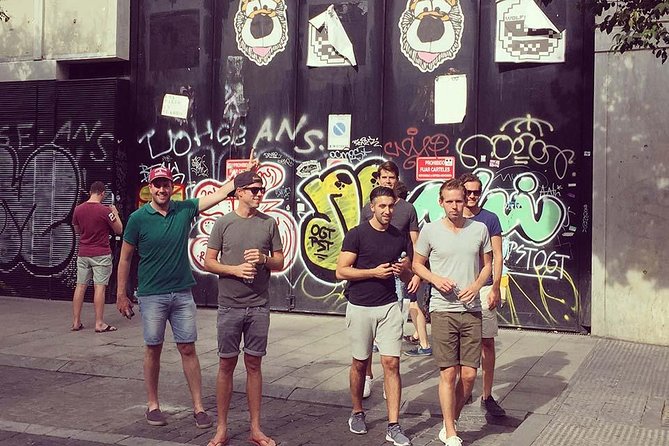
Madrid’s street art is not confined to one polished museum district. It appears on old industrial walls, basement corridors, community gardens, and the edges of ordinary streets. That makes this tour useful: you are not only looking at images, you are seeing how art fits into local life.
The focus is Lavapiés, a district known for its mix of cultures and its independent creative spirit. You walk through streets where legal murals and unsanctioned graffiti can exist close together. A good guide helps you notice the difference in style, purpose, and technique.
I like this format because street art can be easy to skim past. A painted wall may look decorative until someone explains its political message, the festival that produced it, or the stencil method used to create it. The strongest parts of the experience seem to come from that added layer of meaning.
The tour is also a useful choice if you have already seen Madrid’s major sights. It leads you away from the standard route and into a district you might otherwise explore only briefly. You still get a sense of the city, but through working streets, community spaces, and local creative projects.
More Guided Tours in Spain:
- Raval Street Art and Graffiti Guided Tour in Barcelona
★ 5.0 · 81 reviews - Granada: “Street Art & The Caves” Unique Guided Walking Tour
★ 5.0 · 27 reviews - Valencia Street Art | Small Group Guided Tour by Bike
★ 5.0 · 16 reviews
Starting near Teatro Valle-Inclán
The meeting point is Teatro Valle-Inclán at Plaza de Ana Diosdado, in central Madrid. The scheduled start time is 11:15 in the morning, and the tour ends at Plaza de Cascorro. La Latina and Tirso de Molina are the nearest metro stations to the end area, so it is worth checking the route before you set out.
The opening walk heads toward the first art sites. The route passes near Atocha station and the big-headed babies monument, an unusual landmark that helps place the tour in Madrid’s transport and arts quarter. You may also pass the avant-garde art center located in the station’s Mediodía metro area, known for photographic exhibitions and gallery shows.
That opening section matters because it links Madrid’s street art to the city’s wider cultural scene. You are not simply being taken from wall to wall. The guide places the work beside older civic, industrial, and transport spaces.
Wear comfortable shoes. The route lasts about two hours and includes roughly an hour of walking through Lavapiés, with stops where the guide discusses specific pieces. The tour operates in all weather, so a light rain layer or sun protection is sensible depending on the forecast.
La Tabacalera: the main art stop
La Tabacalera is the clearest anchor of the tour. The former tobacco warehouse once employed more than 1,000 people who chopped, shredded, and rolled tobacco. Today, the building is associated with exhibitions, performance, dance, painting, and street art.
The exterior walls are especially important. This is where you can study the scale of the work, the methods used, and the messages behind it. The tour gives about 30 minutes to the La Tabacalera area, though the exact indoor access may vary.
A basement filled with street art projects and stencils adds another dimension. Instead of seeing only a finished mural, you get a sense of how artists use a building as a working surface. The walls can feel crowded with ideas, which is part of the appeal, but it also means you will want time to look closely.
The art connected with La Tabacalera includes work by artists such as Himen, Ze Carrión, and Laguna626. Some artists use their work to protest Spanish Article 626, a law connected with penalties for graffiti creators. That context helps explain why certain pieces feel direct, defensive, or political.
The main limitation is timing. La Tabacalera has restrictive hours on weekdays, so indoor access is not always guaranteed at every time. You should treat the exterior walls as an important part of the experience and view the basement visit as dependent on the day’s access.
Esta es Una Plaza and the value of community space
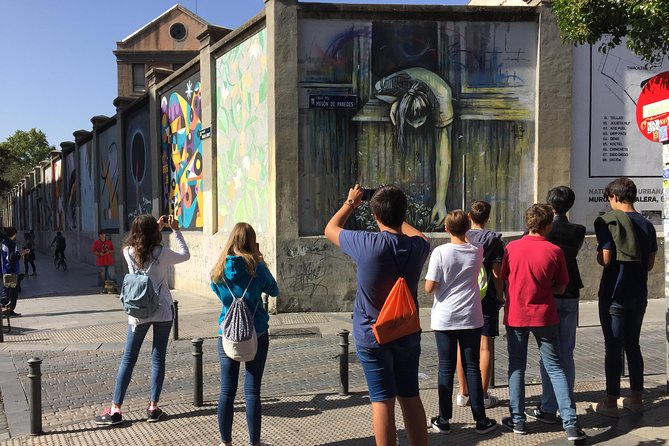
The route also includes Esta es Una Plaza, an urban garden and community project. The visit to its walls is only guaranteed when the site is open, so this is another place where the schedule can affect what you see.
That uncertainty is worth understanding before you book. If the garden is open, it adds a welcome change of pace from painted building fronts and industrial walls. You see how art can work alongside gardening and shared public space.
I like this stop because it shows that Madrid’s street art scene is not only about spray paint. Community art can involve gardens, workshops, social activity, and local control over a piece of the city. It gives the tour a wider purpose.
The tour information also connects this kind of public use with the 15-M Movement, when people reclaimed streets and squares for communal activities. This background makes Campo de Cebada especially meaningful, and it gives you a better way to understand why some empty or neglected sites became gathering places.
A few more mural tours around Spain worth a look
- Barcelona Street Art and Graffitti Bicycle Tour
★ 5.0 · 361 reviews - Madrid: Street Art Tour with Local Graffiti Hunter
★ 4.8 · 270 reviews - Barcelona Street Art Tour with Exclusive Artist Studios Visit
★ 5.0 · 152 reviews - Barcelona: Raval Street Art and Graffiti Walking Tour
★ 4.9 · 60 reviews
Walking through Lavapiés for one full hour
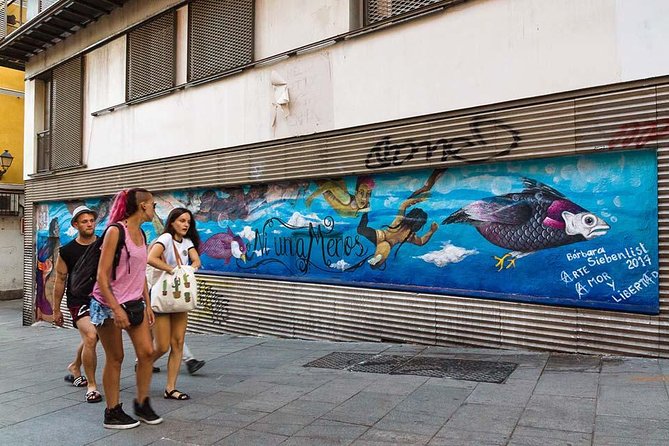
Lavapiés is not just a passage between attractions. The walk through the district takes about an hour, making it the longest part of the route. You will see artwork spread through a multicultural neighborhood and hear about the area’s development and character.
This is where the tour feels most local. Instead of standing in a gallery with a fixed collection, you move through streets where the artwork shares space with homes, shops, community projects, and daily routines. Some pieces may be large sanctioned murals from local festivals. Others may be smaller, less formal, or partly worn away.
The changing nature of the art is both a strength and a weakness. A guide can show you a recently completed mural, as happened during the Calle Lavapiés festival, but that same wall may look different later. Street art is temporary by nature. Do not book this expecting a permanent collection that will look exactly like online photographs.
The strongest guide comments appear to come from guides who care about the neighborhood as well as the art. Santi is praised for being friendly, engaging, and passionate. Julia is described as warm and informative. One guide was an actual street artist who showed personal work, giving the walk a more direct connection to the local scene.
There is one practical issue: you need to stay close enough to hear. One participant found it hard to listen while also looking around, especially when the group was moving. In a group of up to 13, this should be manageable, but you may still want to stand near the guide during explanations.
Campo de Cebada and the finish at Plaza de Cascorro
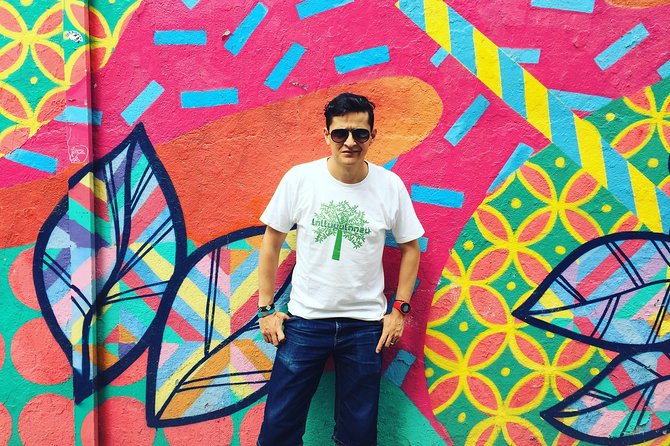
The broader route description includes Campo de Cebada, a former swimming-pool site turned public meeting place and community art project. The space grew out of the 15-M Movement and has been used for films, music, gardening, and neighborhood gatherings.
This is a fitting final idea for the tour. You finish by seeing how public space can be reclaimed and reshaped by local associations. The connection between street art and community life becomes clearer here: walls and empty lots can support discussion, performance, planting, and shared activity.
The scheduled end point is Plaza de Cascorro. That gives you an easy base for continuing through central Madrid after the walk. You can also use the nearby La Latina or Tirso de Molina metro stations.
Because the supplied route details name both Campo de Cebada and Esta es Una Plaza, while the timed itinerary emphasizes La Tabacalera and Lavapiés, I would confirm the exact stops when booking. The route can depend on opening hours, current exhibitions, and the condition of the art.
What the guides add to the experience
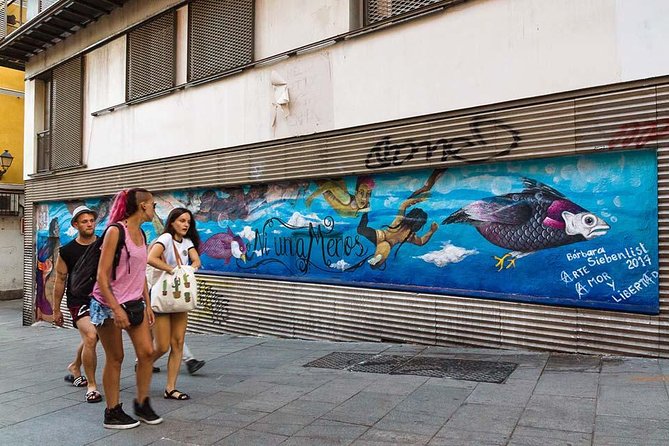
A street art tour lives or dies by its guide. Here, the guide is not only there to point at walls. The best feedback highlights passion, humor, local knowledge, and a willingness to answer questions.
Santi receives particularly strong praise for showing both festival murals and unsanctioned work. That balance is useful because it prevents the tour from treating every painted wall as the same. Julia is also singled out for her friendly and informative approach.
The guide may also adjust the focus to suit the group. One highly positive experience involved a guide responding well to questions and individual interests. That flexibility is valuable when people in the group have different levels of interest in graffiti, politics, design, or Madrid’s social history.
Still, guide quality can vary. One visitor found the tour less organized and had trouble hearing the explanations while looking at the surroundings. Another found the selection of graffiti disappointing and preferred exploring independently afterward. These are not reasons to dismiss the tour, but they are reminders that street art is subjective and that group walks cannot stop at every promising wall.
Is $30.38 good value?
At $30.38, the price is reasonable if you want interpretation rather than a self-guided walk. Every listed stop has free admission, so you are paying for the guide, route planning, local context, and access to places you might not locate easily on your own.
The value is strongest for first-time visitors to Lavapiés or anyone who wants to understand why the artwork is there. The walk connects murals to Article 626, local festivals, community gardens, former industrial buildings, and the 15-M Movement. That is more useful than simply collecting photographs.
The price is less attractive if you already know Lavapiés well or prefer to wander without a schedule. You might also feel disappointed if the indoor parts of La Tabacalera or Esta es Una Plaza are closed. Food, drinks, and hotel pickup are not included, so plan those separately.
The small maximum group of 13 helps support the price. It is not a private tour, but it should be more personal than a large city walk. The experience is offered in English, and the service also lists English, French, and Spanish multilingual guiding.
Who should book this Madrid walk?
I would recommend it to:
- First-time visitors who want a different side of Madrid
- People interested in graffiti, murals, stencils, and public art
- Anyone who enjoys local history tied to real places
- Photographers looking for changing walls and unusual urban scenes
- Visitors who like small-group walks and conversation with a guide
- Families with older children who can manage two hours of walking
I would be more cautious if you want a fixed gallery collection or a purely visual tour with little explanation. The art changes, some locations may be closed, and the guide’s speaking position can make it harder to hear if you fall behind.
Most participants can take part, and service animals are allowed. Since the tour runs in all weather, dress for the conditions. The experience has free cancellation up to 24 hours before the start time, but changes or cancellations inside that window are not refunded.
Should you book the Street Art Guided Tour in Madrid?
Book it if you want street art with context. The best parts are La Tabacalera, the long walk through Lavapiés, and the chance to connect murals with protest, festivals, community gardens, and public life. The praised guides, including Santi and Julia, add warmth and detail that a map cannot provide.
Skip it if you want guaranteed indoor access, a permanent collection, or complete control over the route. For most curious visitors, though, $30.38 is a fair price for two hours in one of Madrid’s most creative districts. Confirm the day’s stops, arrive ready to walk, and stay near the guide when the explanations begin.
FAQ
Where does the street art tour start?
The tour starts at Teatro Valle-Inclán, Plaza de Ana Diosdado, in central Madrid.
What time does the tour start?
The scheduled start time is 11:15 am.
Where does the tour finish?
The tour finishes at Plaza de Cascorro in central Madrid. The nearest metro stations to the end area are La Latina and Tirso Molina.
How long does the tour last?
The experience lasts approximately two hours.
Is the tour offered in English?
Yes. The tour is offered in English, and the guiding service is also listed as multilingual in English, French, and Spanish.
Is entry to the art spaces included?
The local guide service and visit to the Muros La Tabacalera area are included. Food and drinks, hotel pickup, and hotel drop-off are not included. Access to some locations may depend on opening hours.
Can I cancel for a full refund?
Yes. You can cancel at least 24 hours before the scheduled start time for a full refund. Cancellations or changes made less than 24 hours before the start time are not refunded.
Just added around Spain
- Small-Group Graffiti Tour and Workshop in El Carmen★ 5.0 · 2 reviews
- Bilbao Urban and Street Art Walking Tour★ 5.0 · 2 reviews
- Barcelona Street Art, Graffiti and Tapas Tour★ 4.0 · 5 reviews
- Salamanca: Private Guided Street Art Walking Tour★ 5.0 · 2 reviews
- Private Barcelona Street Art Tour★ 5.0 · 2 reviews
- Barcelona | StreetArt Bike Tour Moco Museum★ 4.6 · 13 reviews
- Madrid Street Art Tour (Malasaña Chueca Gran Via & Lavapies)★ 3.5 · 8 reviews
- Málaga: Street Art Tour in the Soho District★ 5.0 · 4 reviews
Madrid Mural Tours, compared.
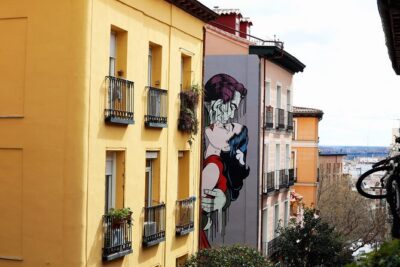
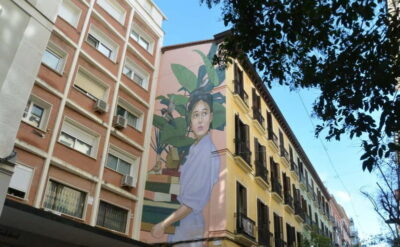
Madrid Street Art Tour (Malasaña Chueca Gran Via & Lavapies)
Read our review →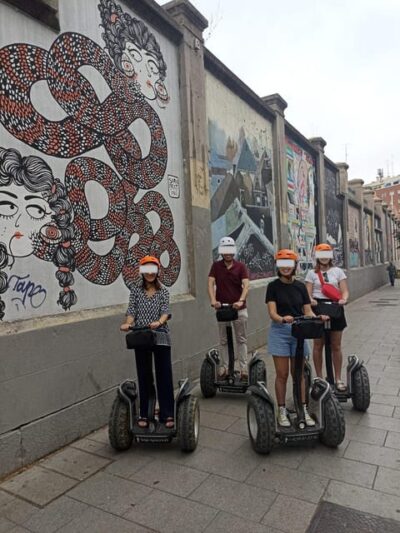
Browse the lists this tour appears in