
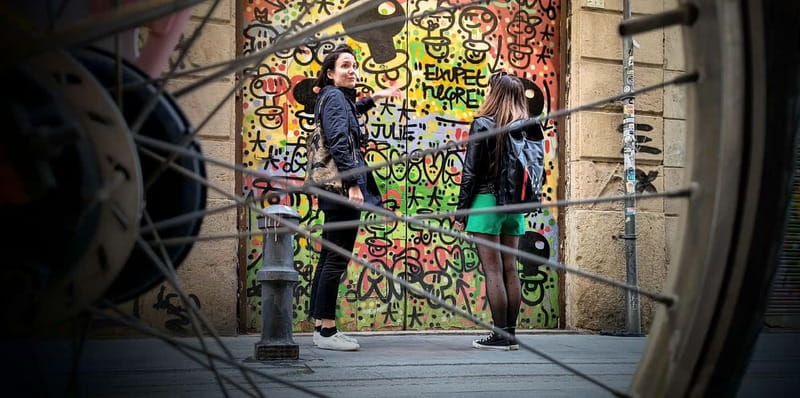
REVIEW · BARCELONA MURAL TOURS
Barcelona | StreetArt Bike Tour Moco Museum
Walls tell Barcelona’s modern story. This 2.5-hour electric bike tour links local graffiti, major murals, public sculptures, and well-known sights across the city. I like the mix of street art and famous landmarks, and I like that the route can change as new paintings appear or old ones disappear. The $34 price is fair for a bike, guide, water, and a moving tour through several central neighborhoods.
The main consideration is pace. You will cover a long route with many short stops, so this is better for seeing a wide slice of Barcelona than for studying each mural at length. Adults should also note that helmets are free for children up to age 16, while adults need to request one ahead of time for an extra charge.
Key points to know before booking
- Keith Haring’s Mural del Sida: One of the tour’s most important art stops, located near the Barcelona Museum of Contemporary Art.
- A long central Barcelona route: You ride from Carrer dels Tallers through Raval, the waterfront, the Gothic Quarter, Passeig de Gracia, and Casa Batlló.
- Street art that keeps changing: The route adapts to Barcelona’s changing walls, so the exact art seen can vary.
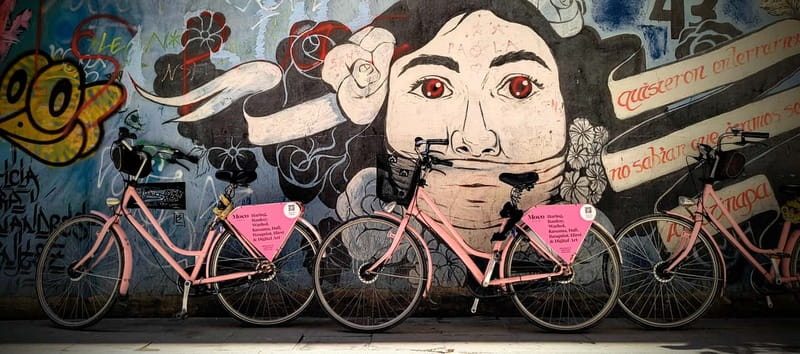
- A practical bike package: Your price includes a bike, bottle of water, handlebar bag, guide, and picture stops.
- A guide-led art lesson: Eirini received special praise for making the subject enjoyable, while another guide helped with food suggestions after the tour.
- Rain or shine: Free ponchos are provided if the weather turns wet, but you should still wear suitable clothing.
Why this tour works for art-minded visitors
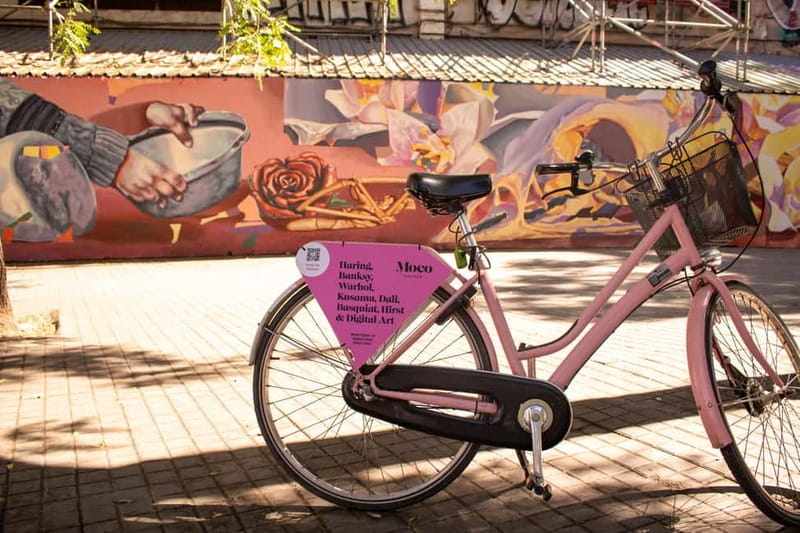
Barcelona is easy to admire through Gaudí, Gothic stonework, and grand boulevards. Street art adds another layer, one that changes faster and often speaks more directly about politics, identity, public space, and daily life.
This tour gives you a practical way to find that art. Instead of wandering the Raval hoping to spot a worthwhile wall, you ride with a guide who can explain who made it, what it means, and why it belongs in that particular part of the city.
I especially like the contrast between formal museums and unsanctioned-looking urban work. The route passes the Centre de Cultura Contemporània de Barcelona, MACBA, the Palace of Catalan Music, Barcelona Cathedral, and Casa Batlló. Between those sights, you see painted walls, public sculpture, old industrial remains, and neighborhood streets.
The tour is conducted in English. The guides are clearly expected to add context rather than simply point at walls. One especially praised guide, Eirini, was described as making the ride both interesting and enjoyable. Another guide gave useful food recommendations after the tour, a nice bonus if you want to turn the afternoon into a local-style meal.
More Street Art Bike Tours in Spain
- Barcelona Street Art and Graffitti Bicycle Tour
★ 5.0 · 361 reviews - Barcelona | Street Art Bike tour
★ 5.0 · 3 reviews - Valencia: Street Art Tour on Bicycle, E-Bike or E-Step
★ 4.8 · 31 reviews
Starting at Carrer dels Tallers and El Gat de Botero
The meeting point is Carrer dels Tallers 45, at the passage for Barcelona Ciclo Tour. Look for the palm tree and enter the passage, where the team will meet you. Arrive about 10 minutes early. That gives you time to find the entrance, get set up, and avoid beginning the ride in a fluster.
The tour opens with a short safety briefing at El Gat de Botero. This large cat sculpture gives you an easy first look at Barcelona’s public art tradition before the focus shifts to painted walls.
The short introduction matters because you will be riding through city streets, not following a closed museum path. You need to stay aware of traffic, pedestrians, fellow riders, and sudden changes in the road. The supplied bike is described as an electric bike, which should make the long route less tiring, but you still need to be comfortable riding.
CCCB and MACBA: Barcelona’s art district
The first major cultural stop is the Centre de Cultura Contemporània de Barcelona, known as CCCB. Here, the guide introduces the Sant Jordi Sculpture and the surrounding skyline. It is a good early stop because it shows how Barcelona places public art beside major cultural institutions.
You will have time for photographs and a guided explanation, though the stop is brief. The schedule allows about 10 minutes, so expect an introduction and a few pictures rather than a full visit inside the center.
The route then continues to the Barcelona Museum of Contemporary Art, or MACBA. The building and plaza are closely linked with Barcelona’s contemporary art identity, and this is one of the places where the tour’s subject feels especially natural.
The listed stop is short, about five minutes, so you should not expect entry to the museum. Instead, the bike group passes through the area and uses it as a setting for nearby street art. This is useful if you want context, but less suitable if you prefer to spend 20 minutes examining every detail of one work.
Keith Haring’s Mural del Sida
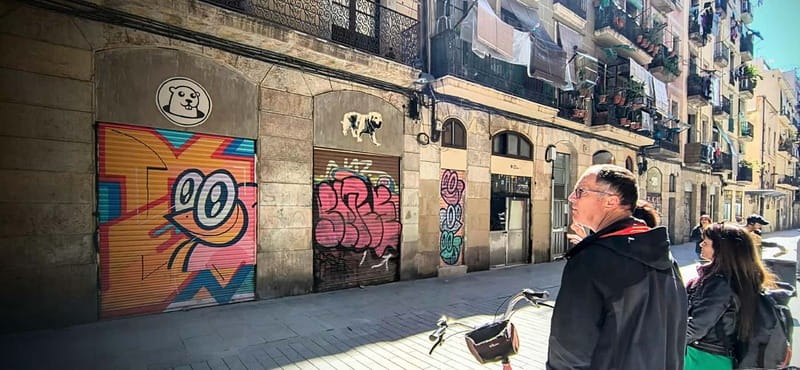
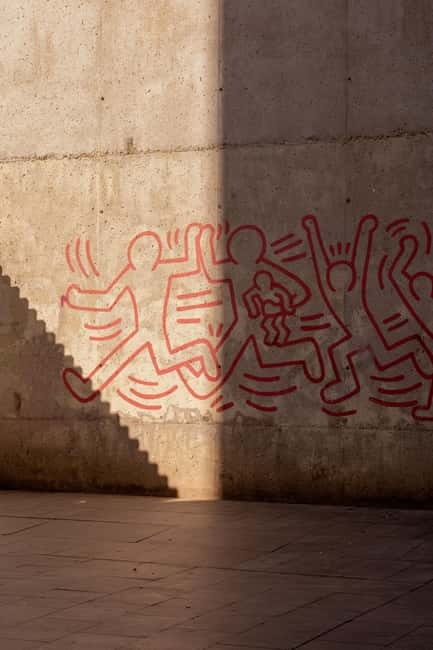
The Keith Haring mural is one of the strongest reasons to choose this route. Mural del Sida, associated with Haring’s work about AIDS, brings an important social message into a public setting. The guide explains the work and its message while you stop for photographs.
This is not simply a colorful wall for a quick picture. It shows how street art can act as public communication, especially when the subject is urgent, political, or personal. The tour places Haring alongside local artists, making it easier to see the connection between international names and Barcelona’s own graffiti culture.
The stop is listed at roughly five minutes, so keep your camera ready and listen closely. If you want a long, quiet look at the mural, the schedule may feel hurried.
More Street Art Museums and Galleries in Barcelona:
- Barcelona: Street Art & Visit to Galleries Tour
★ 4.7 · 30 reviews - Barcelona Art & Wine: Galleries, Studios & Street Art
★ 5.0 · 26 reviews - CDMX: Xochimilco, Coyoacan, Frida Kahlo Museum & Murals Tour
★ 4.4 · 3,025 reviews - Amsterdam: Streetart Museum STRAAT Entrance Ticket
★ 4.8 · 2,137 reviews
Joaquín Costa, Ferlandina, and Xupet Negre
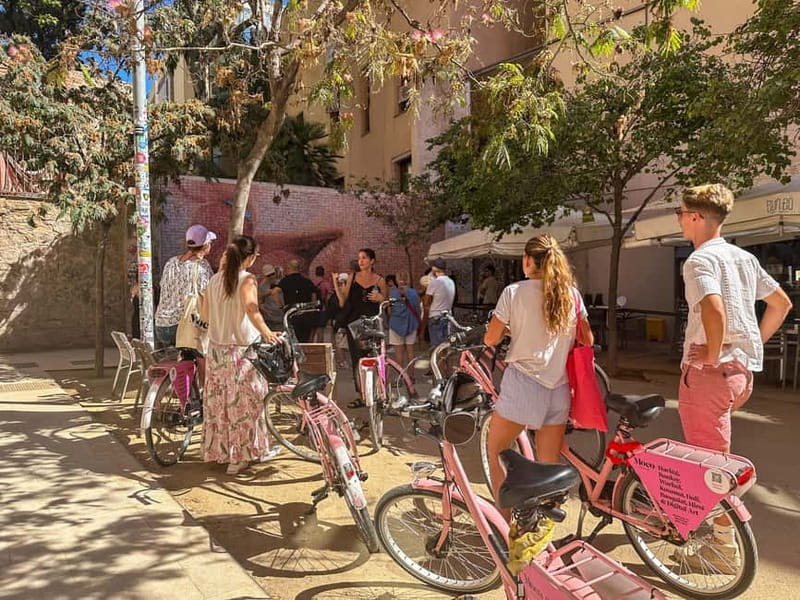
From the MACBA area, the ride moves through streets such as Carrer de Joaquín Costa and Carrer de Ferlandina. These streets are part of the Raval route, where walls can change quickly and where the art feels tied to everyday neighborhood life.
You will see Birdie Al Awan and Xupet Negre, one of the city’s early graffiti works. Xupet Negre is particularly useful for understanding that Barcelona’s street art did not begin with the latest social media-friendly mural. It has older roots, its own local names, and a history linked to the city’s changing public spaces.
The stops are short, often five to ten minutes. I would listen to the guide’s explanation first, then take photographs. Trying to frame every painting perfectly while the group waits is not the best use of the time.
Rambla del Raval and the Feminist wall
The Raval section continues toward Rambla del Raval, where the art shifts in tone and subject. The Feminist wall, Space Invader, and contributions by Ana Eliza are among the works highlighted here.
This part of the route shows why a guide adds value. A wall can look attractive at first glance, but the meaning may not be obvious without background. The guide can point out the messages of strength, diversity, and social identity that connect these works.
You also get a feel for how street art operates in a neighborhood rather than in a gallery. Some paintings are large and easy to spot. Others may be partly covered, weathered, or surrounded by ordinary urban activity. That is part of the appeal, but it also means the exact experience depends on current conditions.
Àgora Benítez and the route toward Paral·lel
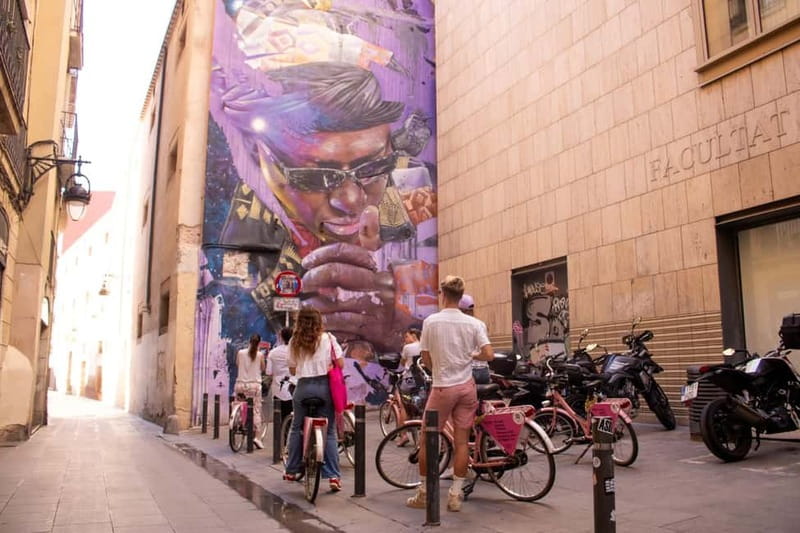
Carrer de l’Aurora brings you to work associated with Àgora Benítez. The stop adds another local voice to the tour, after the international recognition of Haring and Space Invader.
The ride then reaches Avinguda del Paral·lel and the Galería Arnau. This section offers a look at Barcelona’s modern art culture alongside older streets and entertainment venues. The itinerary includes the Theatre Arnau later on, helping connect the public art route with the city’s performance history.
The guide’s explanations are important here because several stops are viewed while riding or passing by. If you want a carefully arranged gallery visit, this will feel too quick. If you want to understand how art appears across different parts of Barcelona, the changing scenery works well.
Jardins de les Tres Xemeneies
The Jardins de les Tres Xemeneies is one of the more distinctive stops. The garden incorporates old industrial elements, including the three chimneys that give it its name. Here, the tour shows how Barcelona can turn former industrial space into a public place for art and recreation.
This is a strong example of the tour’s wider idea: modern expression does not replace the city’s past. It appears beside it. The old structures give the paintings a different setting from the narrow streets of the Raval or the grand facades of central Barcelona.
The stop lasts about 10 minutes and includes photographs, a guided explanation, and views along the route. It is also a useful chance to pause before continuing toward the waterfront.
La Gamba, El Cap de Barcelona, and the waterfront
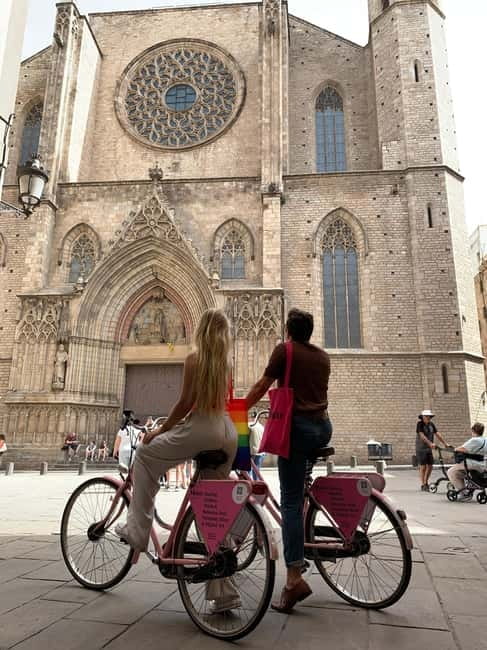
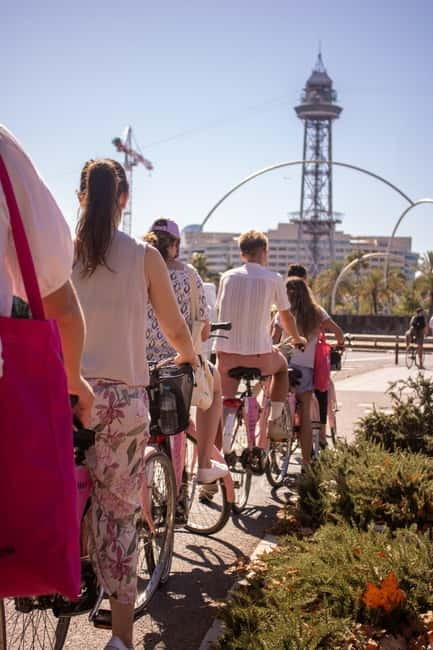
At the waterfront, you see La Gamba, the famous shrimp sculpture by Mariscal. Its playful shape offers a sharp change from the serious social themes of the Haring mural and Feminist wall.
The tour also passes El Cap de Barcelona, a colorful public sculpture by Leinceshtain, and the Columbus Monument. These stops widen the definition of street art. You are not only looking at graffiti. You are also seeing how sculptures, public design, and large-scale art shape the city’s identity.
The waterfront stretch gives you scenic views as you ride, but it may be one of the less focused parts for dedicated graffiti fans. The value here is variety. You see Barcelona’s port area, public sculptures, and major monuments in one continuous ride.
From Theatre Arnau to Carrer de la Riereta
The route returns through several streets and public spaces, including Theatre Arnau, Carrer de la Lluna, Carrer de la Riereta, and Carrer de Sant Pau. These are not just transfer points. They help show how quickly Barcelona’s visual character changes from one block to the next.
The itinerary includes Ágora Juan Andrés Benítez, another place where the guide can connect public art with neighborhood life. Stops typically last five to 10 minutes, with some passing views from the bike.
This is where the electric bike becomes useful. The tour covers a lot of ground in two and a half hours, and the route is more ambitious than a short ride around one plaza. You will need to keep moving, but you see far more than you would on foot in the same period.
Barcelona Cathedral and El Beso
The ride continues toward Barcelona Cathedral and the El Beso photomosaic, also called the Mural del Petó. The photomosaic is made from individual images arranged into a larger picture, giving it a different feel from hand-painted graffiti.
This stop brings the tour into the Gothic Quarter and places modern public art near one of Barcelona’s most recognizable historic buildings. That contrast is one of the route’s best ideas. You are not forced to choose between old Barcelona and new Barcelona. You see both within minutes.
The Cathedral is listed as a pass-by stop, so do not expect an interior visit. El Beso receives a short photo and guide stop, around five minutes. Have your camera ready, especially if the group is moving on quickly.
Palace of Catalan Music, Passeig de Gracia, and Casa Batlló
The final section reaches the Palace of Catalan Music, Passeig de Gracia, and Casa Batlló. These sights are not street art in the narrow sense, but they give you a broader view of Barcelona’s public design and architecture.
Casa Batlló is especially useful as a closing comparison. After seeing spontaneous or wall-based art, you finish near one of the city’s most carefully designed facades. The Palace of Catalan Music adds another major architectural stop, while Passeig de Gracia gives you a grand urban avenue to ride along.
Casa Batlló includes a photo and guided stop of about 10 minutes. Again, the tour does not include entry. You are seeing the outside, hearing the guide’s explanation, and moving on.
The ride returns to Carrer dels Tallers 45. Since the route passes through many central districts, you can easily continue exploring from the meeting point after the tour, although no extra activity is included.
What the $34 price really buys you
At $34 per person, the price is reasonable for a 2.5-hour guided bike ride in central Barcelona. You receive a bike, English-speaking guide, bottle of water, handlebar bag, and picture stops. The guide’s interpretation is the main value, since many of the artworks would be easy to pass without understanding their background.
The price also covers distance. You are not paying for a short neighborhood stroll. The route links the Raval, Paral·lel, waterfront, Gothic Quarter, and Passeig de Gracia. An electric bike helps make that coverage practical.
Still, value depends on your priorities. If you want museum entry, long stops, or a slow photography walk, the tour will not provide that. If you want a lively introduction to Barcelona’s urban art and several major sights in one morning, $34 is a sensible spend.
Who should book this bike tour?
I would recommend it to first-time visitors who want an overview of Barcelona beyond the standard Gaudí circuit. It also suits people who enjoy social and political art, public sculpture, and the chance to see several neighborhoods in one outing.
Families can enjoy it too. One direct account praised the tour as suitable for children, with an interesting and entertaining approach. Children up to age 16 must wear helmets, which are provided free. Adults can request a helmet in advance for an additional cost.
You should be comfortable riding a bike in a city. The activity is not suitable for people who cannot ride or for wheelchair users. Headphones are not allowed, which is sensible because you need to hear the guide and stay alert in the streets.
Bring sunglasses, a hat, sunscreen, comfortable clothes, weather-appropriate layers, and a charged smartphone. You should also carry a passport or ID card, with a copy accepted. The tour operates rain or shine, and a free poncho is provided if needed.
Should you book the StreetArt Bike Tour?
Book it if you want a fast, friendly introduction to Barcelona’s changing art scene, especially if Keith Haring, local graffiti, public sculpture, and neighborhood stories appeal to you. The route is broad, the price is fair, and the guide can turn ordinary streets into meaningful stops.
Skip it if you dislike cycling, need long periods at each artwork, or want to enter museums and monuments. For everyone else, this is a good early-in-your-Barcelona itinerary choice. It helps you learn the city’s layout, gathers plenty of photo stops, and may leave you with a list of murals and neighborhoods worth revisiting on foot.
Free cancellation is available up to 24 hours before the tour, and you can reserve now and pay later. Starting times should be checked when booking, although the stated departure is 11 a.m.
FAQ
Where does the Barcelona StreetArt Bike Tour start?
It starts at Carrer dels Tallers 45, at the Barcelona Ciclo Tour passage. Look for the palm tree and enter the passage where the tour team will meet you.
Where does the tour finish?
The ride ends back at Carrer dels Tallers 45.
How long does the tour last?
The tour lasts 2.5 hours. Starting times can vary, so check availability when booking.
What language is the tour conducted in?
The live tour guide speaks English.
Is a bike included in the price?
Yes. One bike per person is included, along with a free bottle of water and a handlebar bag for belongings.
Is the tour suitable for children?
Children can join, and helmets are provided free for children up to age 16. The tour information also recommends comfortable clothing and weather-appropriate gear.
Are helmets included for adults?
Adults can request a helmet in advance for an additional cost. Helmets are mandatory for children up to age 16.
What happens if it rains?
The tour operates rain or shine. A poncho raincoat is provided free if necessary.
Can I cancel the booking?
Yes. You can cancel up to 24 hours in advance for a full refund. You can also reserve now and pay later.
More Bike Tours in Barcelona
- Barcelona: 3.5-Hour Street Art Tour by Bamboo Bike
★ 5.0 · 56 reviews - Street Art Bike Ride
★ 5.0 · 125 reviews - Cologne: Ehrenfeld Street Art Bike Tour
★ 4.9 · 105 reviews - Urban Adventures Amsterdam Bike Tour, Graffiti and Magnet Fishing
★ 5.0 · 105 reviews
More Street Art Bike Tours in Barcelona
- London Bike Tour: Landmarks, Secret Gems, Pub Stop & Street Art
★ 5.0 · 943 reviews - London: Landmarks & Secrets Bike Tour with Pub & Street Art
★ 4.9 · 314 reviews - Mexico City; ART NACO : Murals & Street Art Bike Tour
★ 5.0 · 284 reviews - Mexico City: Art Naco, murals & street art bike tour
★ 4.7 · 166 reviews
Just added around Barcelona
- Barcelona Street Art, Graffiti and Tapas Tour★ 4.0 · 5 reviews
- Private Barcelona Street Art Tour★ 5.0 · 2 reviews
- Barcelona Street Art, Graffiti & Tapas Tour★ 5.0 · 5 reviews
- Barcelona | Street Art Bike tour★ 5.0 · 3 reviews
- Street Art, Sculptures & Crime Stories Walking Tour – Barcelona★ 5.0 · 11 reviews
- Barcelona: Graffiti E-Scooter Tour★ 4.4 · 9 reviews
- Barcelona: Insider Street Art Tour with Private Studio Visit★ 5.0 · 21 reviews
- Barcelona Art & Wine: Galleries, Studios & Street Art★ 5.0 · 26 reviews
Barcelona Mural Tours, compared.
Barcelona Street Art and Graffitti Bicycle Tour
Read our review →
Barcelona Street Art Tour with Exclusive Artist Studios Visit
Read our review →
Raval Street Art and Graffiti Guided Tour in Barcelona
Read our review →
Private Barcelona Street Art Workshop with a Street Artist
Read our review →
Barcelona Art & Wine: Galleries, Studios & Street Art
Read our review →Browse the lists this tour appears in