
REVIEW · LISBON MURAL TOURS
Lisbon Street Art Tour
Lisbon’s best art may be around the corner. This two-hour walking tour takes you through Graça and Mouraria, two old neighborhoods where giant murals, small stencils, public sculptures, and traditional tiles share the same streets. I like the focus on both famous names, such as Shepard Fairey, Vhils, and Bordalo II, and lesser-known local artists whose work you could easily miss alone. I also like that the tour asks bigger questions about politics, society, and what art is supposed to do.
The main consideration is the pace and terrain. You walk through Lisbon’s hilly streets, and the activity is not suitable for people with mobility impairments. The tour is conducted in French, and the group is limited to eight, so it feels more like a guided walk with conversation than a large sightseeing outing.
Key Things to Know Before You Book
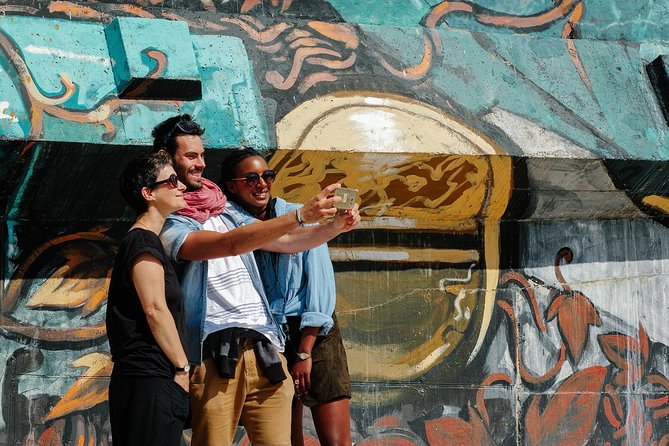
- Graça and Mouraria provide the setting: The tour concentrates on two neighborhoods with a particularly strong collection of street art instead of trying to cover all of Lisbon.
- International and Portuguese artists appear together: You may see work connected with Shepard Fairey, Vhils, Bordalo II, TV Boy, Joana Vasconcelos, Andrea Tarli, Urban Solid, and Utopia.
- The art gets explained, not just pointed out: Peter discusses techniques, artistic statements when available, and the social or political ideas behind each piece.
- Women in street art get attention: The tour addresses how women are entering a field long dominated by men.
- A Lisbon snack is included: You receive either a pastel de nata or a serving of ginjinha, the city’s wild cherry liqueur.
- The small group matters: With no more than eight people, you have a better chance to ask questions and examine smaller works without being hurried along.
Why Graça and Mouraria Make Good Street Art Stages
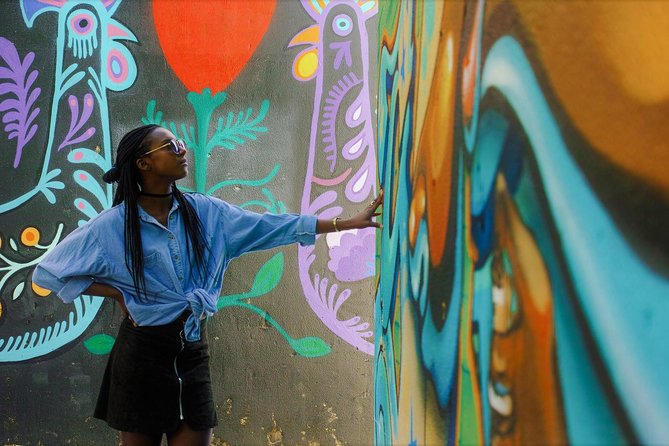
Lisbon is not a city where you can see every important mural from one central square. Street art is scattered across steep lanes, broad avenues, side walls, construction spaces, and overlooked corners. This tour makes a sensible choice by concentrating on Graça and Mouraria.
Graça is known for its elevated streets and traditional Lisbon character. Mouraria is one of the city’s old quarters, with a mix of narrow lanes, local life, public art, and painted walls. The route is not just a parade of giant murals. You may also stop for smaller pieces that reward a closer look.
That distinction matters. Large walls are easy to spot, but smaller works often show more personal humor, careful technique, or a quick response to current events. A guide can help you notice them before you walk past.
I also appreciate that the walk includes more than modern paint. Lisbon’s azulejos, or painted ceramic tiles, are part of the city’s public visual language. Sculptures and other forms of public art enter the discussion too, giving you a wider idea of how Lisbon uses its streets as exhibition space.
The neighborhoods also make the tour feel connected to the city rather than sealed off in a gallery. You are looking at art in the places where people live, work, pass by, and sometimes argue about what belongs on a wall.
A few more mural tours around Lisbon worth a look
- Lisbon: Street Art Tour
★ 4.9 · 1,324 reviews - Lisbon: Kickstart Street Art Walking Tour
★ 4.9 · 717 reviews - Lisbon: Street Art Tuk Tuk Tour
★ 4.9 · 372 reviews
Meeting Shepard Fairey and Lisbon’s Major Names
One highlight is the chance to see work by Shepard Fairey, the American artist known for bold graphic imagery and public-facing political messages. His work gives the guide a useful way to explain how street art can operate between design, protest, advertising, and fine art.
The Portuguese artists provide the local center of the tour. Vhils is especially important in Lisbon’s street art story. His work is associated with carving, cutting, and removing layers of a wall rather than simply adding paint. That technique makes the building itself part of the artwork. You are not only looking at an image. You are looking at a surface that has been scraped, chipped, and reshaped.
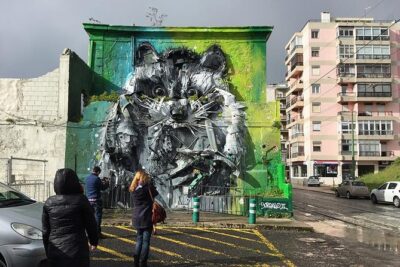
Bordalo II brings another strong idea to the route. His work is closely tied to reused materials and environmental concerns, making discarded objects part of the visual message. This gives you a different way to think about street art. A wall may carry the image, but the materials can carry the argument too.
The tour also includes artists such as TV Boy, Joana Vasconcelos, Andrea Tarli, Urban Solid, and Utopia. Not every artist will appeal to every person, and that is part of the value. You are likely to encounter different styles, from polished large-scale compositions to rougher, quicker pieces.
Peter discusses the techniques used in each work and brings in the artists’ own words when those are available. That keeps the commentary grounded. Instead of assigning a grand meaning to every painted surface, he can separate what the artist has explained from what remains open to interpretation.
Art That Starts Arguments
A good street art tour should not leave you with only a list of names. This one uses the works to raise questions about the place of art in public life.
Who has the right to paint a wall? When does public art improve a neighborhood, and when does it feel imposed? Can a political image remain rebellious after it becomes famous? Is a work still street art if it is commissioned, preserved, or removed from the street?
You will discuss issues of all kinds, including social and political subjects. The point is not to force one answer. It is to give you a way to look at the next mural with more care.
The focus on women entering a traditionally male-dominated field adds another useful layer. Street art has often been presented as a world shaped mainly by men, so learning about women artists helps correct that narrow picture. It also lets you consider who receives space, attention, and credit in public art.
This part will suit you if you enjoy conversation along with sightseeing. If you only want quick photographs of famous walls, the explanations may feel longer than necessary. If you like understanding why a piece exists and how it was made, the two-hour format gives the art more weight.
A Walk Through Graça and Mouraria
The exact order of the stops can vary, but the tour centers on Graça and Mouraria rather than promising an impossible survey of the entire city. That is a strength. Lisbon has too much street art for a short walk to cover it all well.
In Graça, expect the setting itself to demand attention. The streets can be steep, and the changing angles may reveal murals in ways that are easy to miss from a vehicle. You may look across a large wall one moment, then turn into a smaller lane where a compact work deserves equal attention.
Mouraria brings another kind of visual experience. The old quarter has narrow streets and a close-up, street-level feel. Here, murals and small interventions can appear alongside everyday buildings and local businesses. One memorable element from the tour can be an unplanned stop to hear a fado singer, an experience that connects the walk to Mouraria’s musical identity.
That fado moment should be treated as a possible bonus rather than a guaranteed feature. It appeared during one of the reported outings, but the core activity is the street art walk. The included tasting is the dependable local extra: you receive a pastel de nata or ginjinha.
The route also includes places that may feel like secrets within larger streets. You might see monumental walls in prominent locations, then turn toward a quieter corner for a smaller work. That mix keeps the walk from becoming visually repetitive.
Same walls, a different guide:
- LISBON Street Art Tour
★ 5.0 · 371 reviews - 3-Hour Guided Street Art Walking Tour of Lisbon
★ 5.0 · 278 reviews - Lisbon Street Art Walking Tour
★ 5.0 · 141 reviews - Lisbon: 3-Hour Street Art Tuk Tuk Tour
★ 4.8 · 86 reviews
Peter’s French-Language Guiding
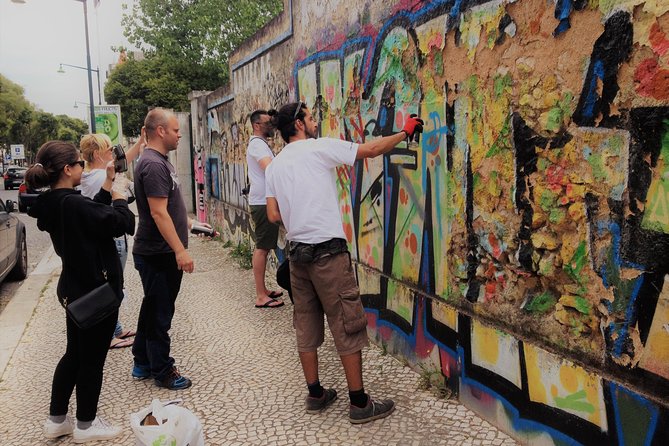
Peter is the named guide for this experience, and the strongest praise centers on his explanations and friendly manner. He points out a large number of works, identifies the artists, and explains the techniques behind them.
The language is important. This tour is offered in French, not English. If you understand French comfortably, the small group should make it easier to follow the conversation and ask questions. If you do not speak French, you should choose a different tour rather than assume the visual nature of street art will make language unnecessary.
A maximum of eight participants is a useful limit for this subject. Street art often requires people to stop at different angles, look up, and gather around a smaller work. A large group would make that awkward. With fewer people, Peter can spend time on a detail without blocking the street or losing half the group.
The guide’s role is especially useful when an artwork is partly hidden, damaged, or difficult to interpret. Lisbon’s street art changes. Paint fades, walls are repaired, and new work appears. A guide helps you understand what you are seeing at that moment, even when the piece is not presented like a permanent museum object.
The Pastel de Nata and Ginjinha Pause
The included local specialty adds a small but welcome taste of Lisbon. You receive a pastel de nata, the familiar custard tart, or ginjinha, a sour cherry liqueur served in Lisbon.
This is not a meal, and you should not book the tour expecting a full food experience. It is simply a pleasant local touch after spending time in the streets. The choice also gives you some flexibility: a sweet pastry may suit you better in the middle of a walking day, while ginjinha offers a more distinctly Portuguese sip.
Coffee and other hot or cold drinks are not included. Bring water, especially if you are visiting during warm weather or are not used to Lisbon’s slopes. Comfortable shoes are essential.
The occasional fado connection makes the tasting feel more rooted in the neighborhoods. It is a reminder that Lisbon’s public culture is not divided neatly into art on walls, music in venues, and food at tables. On this walk, those elements may overlap.
Is $41 a Fair Price?
At $41 per person, this is not the cheapest way to see walls in Lisbon. You can walk through Graça and Mouraria without paying anything, and you can certainly spot large murals on your own.
The value comes from interpretation. You are paying for two hours of route planning, artist background, technique, social context, and a small local tasting. The small group also matters because the experience depends on stopping, looking, and discussing. A large group or a basic photo walk would offer less room for that.
I think the price makes sense if you want to understand the work rather than simply collect photographs. It is less compelling if you already know Lisbon’s street art well or prefer independent exploration without a guide.
The tour may also save you time. Lisbon’s public art is spread out, and a self-guided search can involve plenty of wrong turns. Here, you go directly to two neighborhoods selected for their concentration of works.
Who Will Enjoy This Walk Most
This tour suits you if you like contemporary art, photography, local culture, or thoughtful city walks. It is also a good choice if you have already seen Lisbon’s major monuments and want something less formal.
You do not need specialist art training. The guide explains the works in accessible terms, and the discussion includes basic techniques as well as broader questions. Curiosity is more useful than prior knowledge.
It is particularly suitable for French-speaking couples, friends, and solo visitors who prefer a small group. The limit of eight keeps the experience personal without making it a private tour.
You should think twice if hills are difficult for you, since the activity is specifically not suitable for people with mobility impairments. You should also reconsider it if you want a purely visual outing with little explanation. The commentary is a central part of the experience.
Practical Details for a Smoother Morning or Afternoon
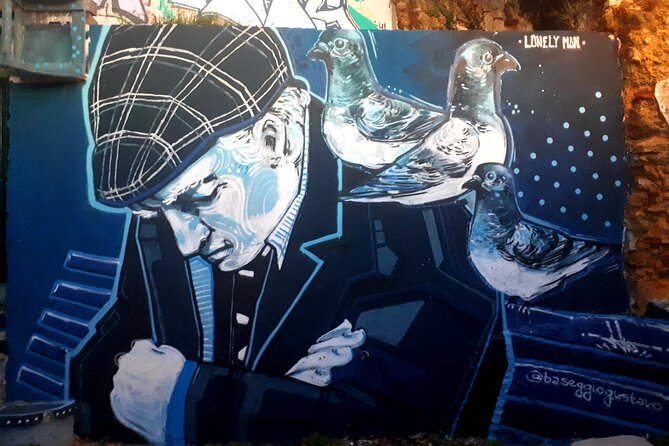
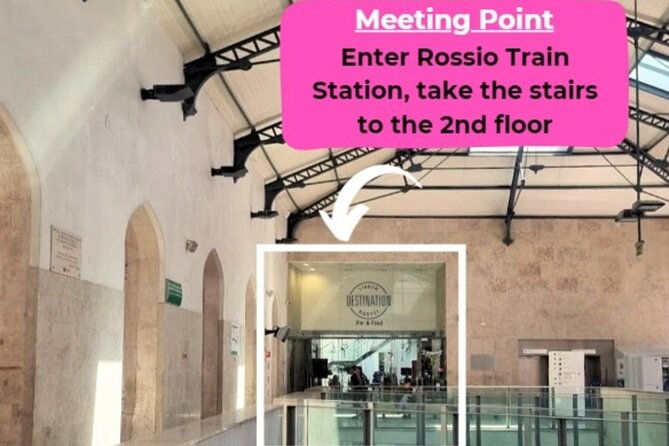
The meeting point is in front of the church. Since that description is brief, check the precise location shown during booking and arrive with comfortable shoes already on.
The walk lasts two hours, so plan your day around a compact activity rather than a half-day excursion. You will have time afterward to continue exploring Lisbon, eat a proper meal, or return to a favorite wall for another look.
Bring water. Coffee and other drinks are not included, and Lisbon’s hills can make a short walk feel more demanding than the clock suggests.
The tour allows free cancellation up to 24 hours before the start for a full refund. You can also reserve now and pay later, which helps if your Lisbon plans are still shifting.
Should You Book the Lisbon Street Art Tour?
Book it if you want more than a list of mural locations. Peter’s explanations, the focus on Vhils and Bordalo II, the appearance of international artists such as Shepard Fairey, and the attention given to women in street art make this a thoughtful two-hour introduction.
The included pastel de nata or ginjinha is a nice local extra, and a possible fado encounter adds flavor to the route. Just remember that it is a walking tour through hilly neighborhoods, conducted in French, with no more than eight participants.
For a French-speaking visitor who enjoys art and wants to see Graça and Mouraria with context, $41 is a reasonable price. For anyone with mobility limitations or no working French, choose another Lisbon activity.
FAQ
Where does the Lisbon Street Art Tour take place?
The tour focuses on the Lisbon neighborhoods of Graça and Mouraria, which have particularly strong collections of street art and public art.
How long does the tour last?
The walking tour lasts two hours.
What language is the tour conducted in?
The live tour guide conducts the experience in French.
How large is the group?
The group is limited to eight participants.
Which artists might I see?
The tour can include work by Shepard Fairey, Vhils, Bordalo II, TV Boy, Joana Vasconcelos, Andrea Tarli, Urban Solid, and Utopia, along with other local and emerging artists.
Is food or drink included?
You receive either a pastel de nata or ginjinha. Coffee and other hot or cold drinks are not included.
What should I bring?
Wear comfortable shoes and bring water.
Is the tour suitable for people with mobility impairments?
No. The activity is not suitable for people with mobility impairments.
Can I cancel the booking?
Yes. You can cancel up to 24 hours in advance for a full refund. You can also reserve now and pay later.
Just added around Lisbon
- Street Art Tour by Tuk Tuk Joy★ 5.0 · 2 reviews
- Lisbon Street Art and Lookout Point Tour★ 5.0 · 17 reviews
- Street Art – Tuk Tuk Tour★ 5.0 · 17 reviews
- Lisbon Street Art Walk★ 5.0 · 17 reviews
- Street Art at Lisbon★ 5.0 · 2 reviews
- Private Tuk Tuk of the Old Town Lisbon and Street Art Highlights★ 5.0 · 20 reviews
- Discover Lisbon’s Best Street Art★ 5.0 · 6 reviews
- Lisbon Street Art – Private Tuk Tuk Tour with pickup★ 5.0 · 17 reviews
Lisbon Mural Tours, compared.


3-Hour Guided Street Art Walking Tour of Lisbon
Read our review →

Browse the lists this tour appears in