
REVIEW · ITALY MURAL TOURS
Palermo: Street Art and Urban Life Walk
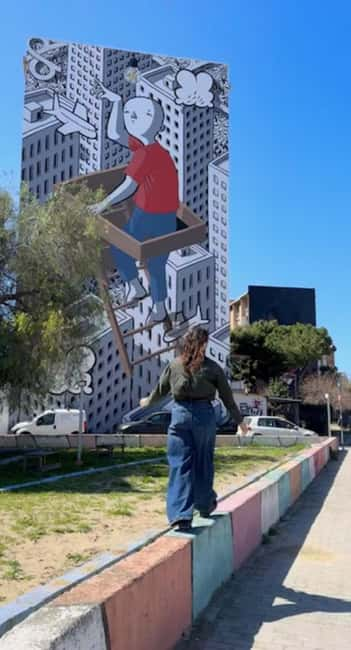
Street art tells Palermo’s other story. This three-hour walk links Vucciria and Kalsa with the outer neighborhood of Sperone, showing you murals, painted shutters, market streets, and ordinary city life that a landmark tour can miss. I like the mix of major artists such as TVBoy, Millo, and Igor Scalisi Palminteri, and I like that tram tickets and an artisanal gelato tasting are included. The main consideration is that this is not a classic sightseeing tour, so anyone expecting Palermo’s cathedral, palaces, and famous monuments should choose a different outing or add this one to a standard city tour.
The guide, Elena, is a major part of the experience. She brings street art together with Palermo’s politics, mafia history, social problems, and recent changes, while keeping the walk personal and lively. You should also expect some walking in the sun, time on public transport, and a visit to a poorer residential area rather than a polished tourist quarter.
Key points at a glance
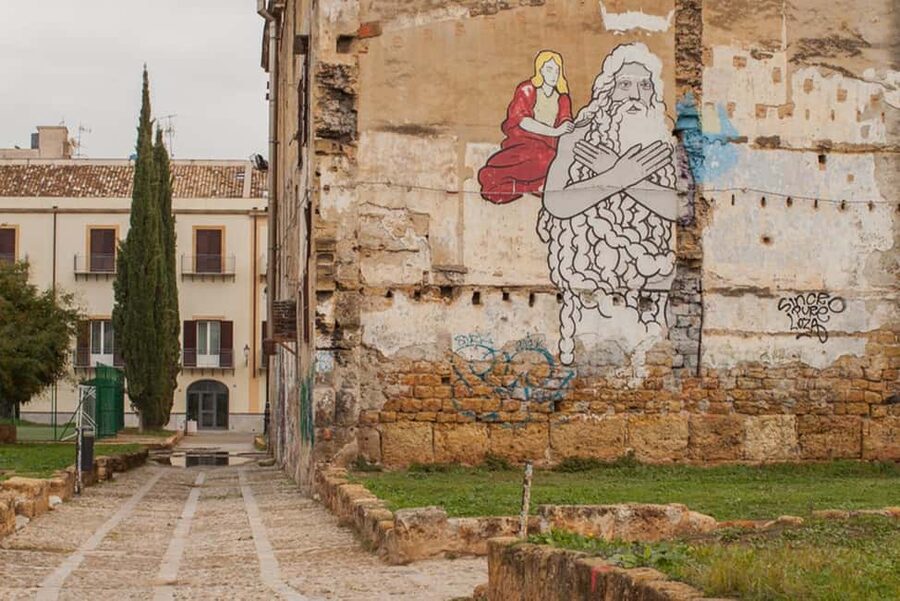
- Murals across three very different areas: Begin in Vucciria, continue through Kalsa, then ride the tram toward Sperone.
- Art with a local point of view: Elena explains the city behind the pictures, including politics, mafia history, hardship, and renewal.
- Works by well-known artists: Look for pieces connected with TVBoy, SID, Igor Scalisi Palminteri, Rosk & Loste, Medianeras, and Millo.
- A small group of no more than 10: The size makes it easier to ask questions and talk with the guide.
- Gelato and tram tickets included: The extras add comfort and value without turning the tour into a food outing.
- A candid view of Palermo: You see creative work beside ordinary homes, shops, market streets, and signs of social change.
Starting in Vucciria, where art meets daily life
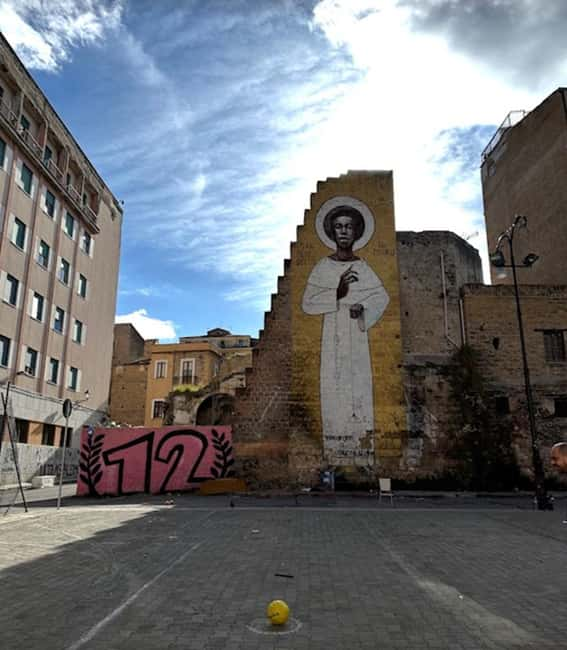
The meeting point is Epic Home on Via Argenteria, 20, in Vucciria. This puts you in a useful place to begin. Vucciria is not simply a backdrop for photographs. It is a working part of Palermo, with crowded market energy, narrow streets, painted shutters, and the signs of everyday urban life.
The first portion is on foot, and the pace is designed for looking rather than racing from one sight to another. Your guide may point out a mural on a wall, a smaller work on a doorway, or an unexpected detail on a shutter. That matters because Palermo’s street art is not confined to a gallery or one official open-air exhibition. It appears among homes, businesses, traffic, and people getting on with their day.
I like this opening because it gives you a quick lesson in how to read the city. A large mural may be easy to spot, but the smaller pieces often require you to look up, around corners, and across side streets. The contrast between bold public art and worn urban surfaces is part of the experience, not something the tour tries to hide.
The guide’s commentary also keeps the art from becoming a simple checklist of names. Elena has been praised for explaining the cultural and political background behind the works, including the harder parts of Palermo’s story. You may hear how artists use public walls to discuss identity, hope, community, and change.
A few more mural tours around Italy worth a look
- Naples Spanish Quarters Walking Tour Street Art, Folklore & Sweet
★ 5.0 · 797 reviews - Naples: Spanish Quarters Folk Street Art w/ Sweets Tasting
★ 4.9 · 788 reviews - Graffiti art tour in Rome
★ 5.0 · 714 reviews
Kalsa offers a quieter change of pace
From Vucciria, the walk continues into Kalsa. The route takes about 30 minutes, though the actual rhythm may change with weather, events, and local conditions. Kalsa provides a different mood from the market area, with a quieter feel and more room to notice how art sits within residential streets.
This section is useful if you want to understand Palermo beyond its postcard sights. You are not just looking at a finished artwork. You are seeing the wall, shutter, street, and neighborhood around it. A mural can brighten a tired facade, draw attention to a local issue, or turn an overlooked corner into a place people notice.
Works connected with artists such as TVBoy and SID appear during the city-center portion. The exact order can vary, so do not treat the tour as a fixed scavenger hunt. Some pieces may be affected by weather, public events, or changes in the city. That flexible approach is sensible for street art, which can be painted over, altered, or temporarily blocked.
The Kalsa portion is also where Elena’s wider knowledge becomes especially useful. Her explanations go beyond technique and color. She connects what you see with the city’s recent development and the daily realities of people who live there. That makes the tour feel more like a conversation about Palermo than a lesson delivered at a series of stops.
The tram ride changes the view of Palermo
The first tram ride takes about 15 minutes. Your ticket is included, so you do not need to work out the local fare during the tour. More important, the tram carries you away from the center and gives the experience a clear change of setting.
This is not a sightseeing tram. It is part of the point. You move as local residents do, leaving the areas most visitors already know and heading toward Palermo’s creative outskirts. The ride helps show that street art is not only a feature of the historic core. It also appears in residential districts where artists, residents, and local projects shape the public view of the neighborhood.
For some people, this will be the strongest part of the outing. You get a sense of how Palermo connects its center with its outer districts, and you see the city as a place where daily life continues outside the main tourist routes. For others, the transport time may feel less exciting than a continuous walk. I would choose this experience only if you value context and local life as much as famous sights.
Sperone brings large-scale work and social context
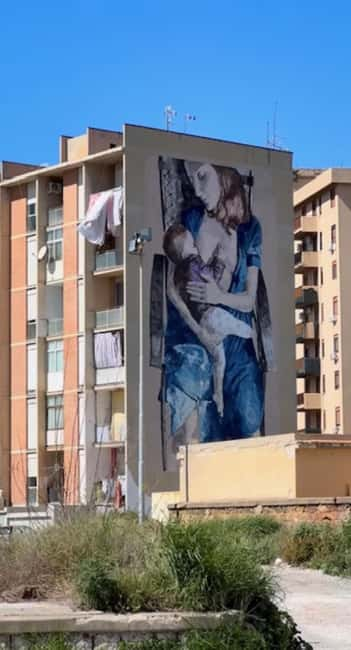
After the tram, the tour continues on foot for about 30 minutes in Sperone. This is the most substantial change from the center. The art here has a larger physical presence, and the neighborhood setting gives it more weight.
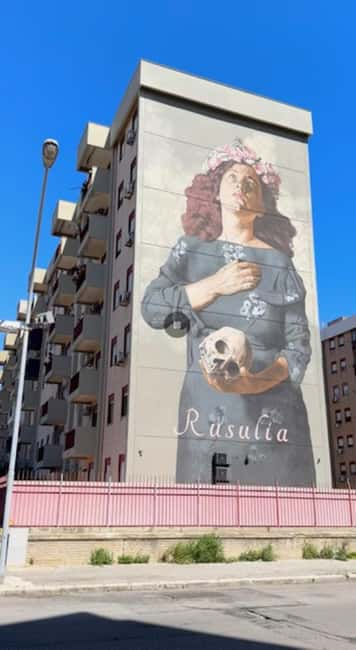
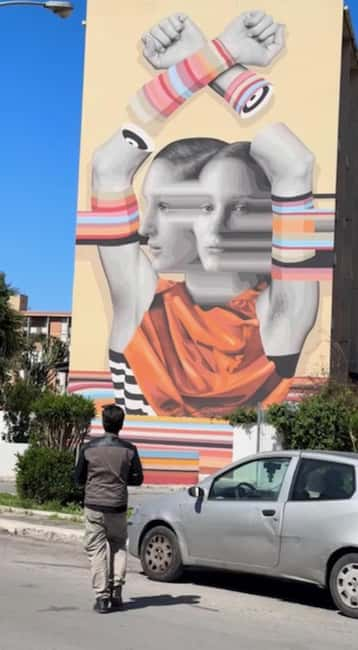
The area includes large works associated with Igor Scalisi Palminteri, Rosk & Loste, Medianeras, and Millo. These pieces are part of the neighborhood’s visual identity, rather than isolated attractions placed in a historic square. You may find yourself looking at a huge wall and then immediately noticing the homes, streets, and residents around it.
That combination is central to the tour’s purpose. Elena does not present Sperone as a decorated stop with all the rough edges removed. Instead, she explains the positive and difficult sides of the area. One participant described the experience as a visit to one of Palermo’s poorer districts, with a frank look at both its gains and its problems. That honesty will appeal to you if you want a grounded view of the city, but it may feel uncomfortable if you prefer a light art walk with little social discussion.
The art can serve as a sign of care and possibility in places that have faced neglect or hardship. It does not solve those problems, and the tour does not pretend that a mural can do so. What it can do is change how you look at a street, give local projects visibility, and show how public art can become part of a neighborhood’s ongoing story.
Same walls, a different guide:
- Naples: Street Art, Wine and Food Tasting Walking Tour
★ 5.0 · 163 reviews - Naples Essentials: Monuments, Local Life & Street Art
★ 4.9 · 79 reviews - 4×4 tour of Orgosolo: Murals and typical lunch at the shepherd’s
★ 5.0 · 76 reviews - Rione Sanità tour among baroque, revival, street art & food
★ 4.8 · 59 reviews
A second tram ride and the return walk
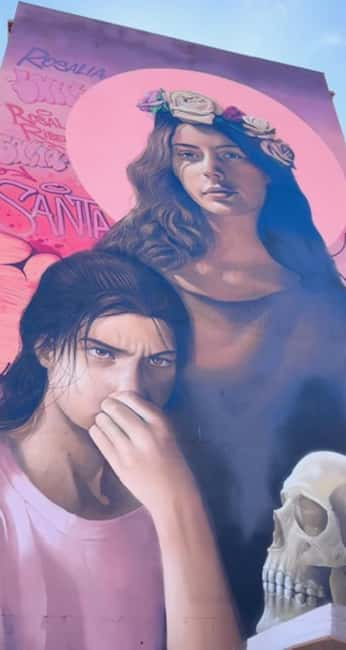
The itinerary includes another tram ride of roughly 15 minutes, followed by about 25 minutes on foot before returning to Via Argenteria, 20. The route may not follow the exact order described here. The guide can adjust the sequence for events, weather, and practical conditions.
That flexibility is worth understanding before you book. You are not buying a rigid list of stops with a guarantee that each work will be viewed in a particular order. You are joining a live walk through an active city. Street art changes, public spaces get busy, and the guide may need to make sensible adjustments.
The final walk brings the group back toward the starting point. Along the way, you have time to think about the contrast between central Palermo and Sperone. The experience works best as a complete arc: market streets first, a quieter central district next, public transport outward, then large-scale art in a neighborhood shaped by social change.
Why Elena makes a difference
The strongest praise for this experience centers on Elena’s ability to connect facts with feeling. She is described as offering broad and detailed information about Palermo, but the real value is how she uses it. Street art leads into city politics, mafia history, rebuilding, and the personal experience of living in Palermo.
That range gives the tour more substance than a list of artist names. You can ask questions and follow up on subjects that interest you. The small group, limited to 10 people, should help keep the exchange personal. Past groups have even spoken with passersby and local residents during the walk, a reminder that this is a public neighborhood experience, not a closed performance.
Elena also seems to bring warmth to serious subjects. The tone is not purely academic, and it is not a sales pitch for Palermo. You get positive stories alongside difficult ones. That balance is important in a city with clear beauty, major social challenges, and a complicated modern identity.
If you have already seen the main monuments, this approach can add a new layer to your visit. It can also work early in your stay, since the guide’s comments about neighborhoods and local life may help you understand later walks around the city.
What the $45 price includes
At $45 per person, this is reasonably priced for a three-hour small-group experience. The fee includes a specialist local guide, both tram tickets, and an artisanal gelato tasting. The tram tickets are a small but useful touch, while the gelato gives the route a pleasant break without making food the main subject.
The best value comes from the guide rather than the transport or dessert. You are paying for access to parts of Palermo that you may not locate on your own, plus interpretation that links art to current city life. If you only want to photograph murals, you could find some independently for less. If you want to understand why the works are there and how they relate to the neighborhoods, the price is easier to justify.
Drinks are not included. Wear comfortable shoes, and bring a hat, sunscreen, and a camera. The three hours include walking, tram travel, and time spent standing while the guide explains the works, so this is not a sit-down activity.
The experience is wheelchair accessible, according to the supplied information. Since the route includes public streets and tram travel, you may still want to confirm the exact conditions for your chosen date if you have specific mobility needs.
Who should choose this walk?
I would recommend it most strongly to you if you meet one or more of these conditions:
- You have already seen Palermo’s major landmarks and want a different angle.
- You care about contemporary art, public space, or local social issues.
- You prefer a small group and the chance to ask questions.
- You want a guide who discusses difficult subjects as well as attractive ones.
- You are comfortable walking through ordinary residential districts.
- You enjoy using public transport as part of a city experience.
It is less suitable if your main goal is ancient monuments, grand interiors, or a neat route through Palermo’s most famous sights. It is also not the best fit if you want a purely cheerful art tour. Sperone and the discussions of poverty, mafia history, and urban problems give the afternoon more seriousness.
English, Italian, and Spanish are available. The maximum group size of 10 is another reason to book if you value conversation over a large group with limited contact with the guide.
Practical timing and booking advice
Allow the full three hours. The published walking sections add up to about 85 minutes, while the two tram rides total about 30 minutes, and the rest is used for explanations, viewing art, questions, and the gelato stop. The route may be rearranged, so arrive ready for a live urban walk rather than a timed museum visit.
You can cancel up to 24 hours before the experience for a full refund, and the reserve-now, pay-later option gives you some flexibility. Starting times depend on availability, so check the date you want rather than assuming there is one daily departure.
The meeting point is Epic Home at Via Argenteria, 20. Since the tour returns there, it is easy to treat the outing as a self-contained part of your Palermo day. Still, plan your shoes and sun protection carefully. The route moves between exposed streets, public transport, and residential areas, with no promise that every section will offer shade or a place to sit.
Should you book the Palermo street art walk?
Book this experience if you want Palermo to feel like a living city rather than a row of famous buildings. The combination of Vucciria, Kalsa, and Sperone gives you three different settings, while the tram rides show how the center relates to the outer districts. The most valuable part is Elena’s local perspective, especially her ability to connect public art with politics, mafia history, hardship, and renewal.
Skip it if you want a traditional introduction to Palermo’s monuments. But if you have already seen the cathedral and palaces, or if you want to understand the city through its walls and neighborhoods, the $45 cost is fair. Bring comfortable shoes, arrive open to serious discussion, and leave room for the gelato.
FAQ
Where does the Palermo street art walk begin?
It begins at Epic Home, the tour operator’s base at Via Argenteria, 20, in Vucciria.
How long does the experience last?
The experience lasts three hours.
Which neighborhoods does the route visit?
The route includes Vucciria, Kalsa, and Sperone, with tram travel between the central areas and Palermo’s creative outskirts.
Are tram tickets included?
Yes. Tram tickets are included in the price.
Is gelato included?
Yes. An artisanal gelato tasting is included. Drinks are not included.
Which languages are available?
The live tour guide is available in English, Italian, and Spanish.
How large is the group?
The experience is limited to 10 participants. It is also listed as wheelchair accessible.
Just added around Italy
- Art & Craft: Beer Tour with Street Art in Rome★ 4.5 · 6 reviews
- Torpignattara Photo Tour: melting pot, street art and politics★ 5.0 · 5 reviews
- Naples Murals Catacombs and Folklore Sanità District Tour★ 4.5 · 5 reviews
- Street Art of Spanish Quarters and Maradona Tour★ 3.5 · 3 reviews
- The Spanish Quarters, Street Art and Local Market Tour in Naples★ 5.0 · 23 reviews
- Private Street Art Tour: Exploring Milan’s Hype Neighborhoods★ 5.0 · 2 reviews
- Street Art&Urban Vibes in Milan’s Most Exciting Rising Areas★ 4.4 · 5 reviews
- Spanish Streets – Maradona Street Art & Murals★ 5.0 · 3 reviews
Italy Mural Tours, compared.
Naples Spanish Quarters Walking Tour Street Art, Folklore & Sweet
Read our review →
Spanish Quarters Folk Street Art w/ Sweets Tasting
Read our review →
Naples Essentials: Monuments, Local Life & Street Art
Read our review →
4×4 tour of Orgosolo: Murals and typical lunch at the shepherd’s
Read our review →
Rione Sanità tour among baroque, revival, street art & food
Read our review →
The Spanish Quarters, Street Art and Local Market
Read our review →Browse the lists this tour appears in