
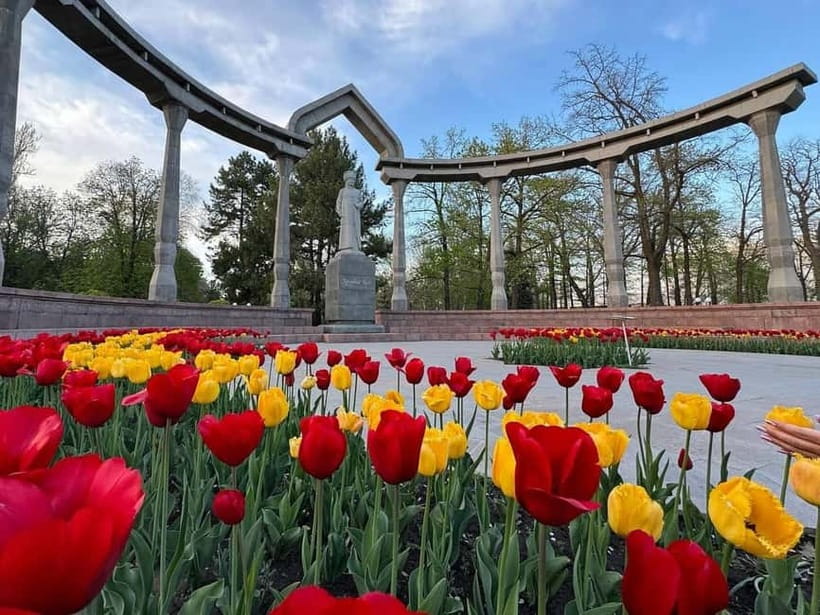
REVIEW · HISTORICAL TOURS
Bishkek Street Art & Kyrgyz Nomadic History (Walks & Talks)
Look up, and Bishkek starts talking. This walking tour pairs Soviet-era mosaics, modern street art, parks, statues, and Kyrgyz cultural stories in a useful first look at the capital. I especially like the way it connects public art with the country’s past, and the chance to browse local souvenir shops along the route. The main caution is that the street-art portion may feel lighter than expected, and one recent booking finished in about 2.5 hours instead of the advertised 3.5.
The tour costs $38 per person and uses English or Russian-speaking guides. Sofia, Alex, and Andrew have led recent outings, with Sofia praised for her warm manner and Alex for explaining both distant history and more recent events. I would book it early in your Bishkek stay, since it helps you get your bearings before heading farther into Kyrgyzstan.
Key points to know before you book
- Soviet mosaics are the real stars: Public artworks and building mosaics offer a visual way into Bishkek’s Soviet past.
- Ala-Too Square anchors the walk: You spend substantial time around the city’s central square, monuments, and public spaces.
- The guide shapes the experience: Sofia and Alex received especially strong praise for clear explanations, personal insight, and patient answers.
- Souvenir shopping is built in: The route includes local crafts and souvenir shops, useful if you want a Kyrgyz-made keepsake.
- Expect history as well as art: Stories cover Kyrgyz traditions, legends, myths, economics, and life in the republic.
- Allow for some timing flexibility: The listed duration is 3.5 hours, but at least one recent outing lasted closer to 2.5 hours.
Why Bishkek’s public art deserves your attention
Bishkek can seem broad and quiet at first glance. Its streets are lined with trees, open squares, monuments, and large public buildings rather than the tightly packed old centers found in many European capitals. This tour gives you a reason to slow down and study the walls.
The Soviet mosaics are not just decoration. They were made as public statements, often tied to work, education, agriculture, industry, friendship, or official celebrations. Here, the art becomes a doorway into the political and cultural changes that shaped Kyrgyzstan.
The experience also looks at works connected with the centenary of Kyrgyzstan’s association with the Russian Empire. That subject can be historically complicated, so a good guide matters. The tour presents the cultural values of the Kyrgyz people alongside the Soviet period and more recent national identity.
I like this approach because you are not simply ticking off monuments. You are asking why a particular image was placed on a public building, who it was meant to honor, and how Kyrgyz traditions were presented during different periods.
The modern street art adds another layer. It gives you a contrast between official public art from the Soviet years and newer work that may feel more personal, local, or open to interpretation. Still, you should not book this expecting a nonstop mural crawl. One recent account found there was less street art than anticipated. The stronger reason to go is the mix of art, history, and conversation.
More History Tours in the world:
- 3-Hour Atlanta Beltline Food, Street Art and History Tour
★ 5.0 · 345 reviews - History and Murals: Walking Tour Guadalajara
★ 5.0 · 237 reviews - Walking Tour – Impressive murals in Historical Center of Mexico City
★ 5.0 · 224 reviews
Starting at the Kyrgyz Republic flag
The meeting point is the Paramount Kyrgyz Republic Flag. From there, the guide leads you into central Bishkek on foot. This is a practical starting place because the tour stays in the city center and returns to the same location.
At the beginning, expect a short orientation and safety briefing. The guide sets the tone for the walk and explains what you will see in the central streets. Since the route involves several hours on foot, wear comfortable shoes and bring water, particularly in warm weather. Food and drinks are not included.
This opening is also a good time to tell the guide what interests you. The experience can cover art, history, Kyrgyz traditions, legends, economics, and everyday life. Alex was praised for answering questions patiently, while another guide helped arrange a taxi after the tour. That suggests the conversation can be practical as well as historical, though the exact depth will depend on your guide and the questions you ask.
Ala-Too Square and the city’s central story
Ala-Too Square receives about 1.5 hours of the scheduled visit. That is a substantial portion of the walk, and rightly so. The square is one of Bishkek’s main public spaces, where national symbolism, monuments, ceremonies, and modern city life come together.
You will walk around the square, pass nearby sights, and hear about the events and ideas associated with the capital. The guide may use statues and public buildings as visual prompts, helping you connect what you see with Kyrgyz history and political change.
This section is especially useful on your first day. Instead of wandering past a monument without context, you can ask what it represents and why it matters. Several guides have been praised for giving enough detail without burying the group in dates and names. That balance suits you if you want a clear introduction rather than a university lecture.
The square also gives you a sense of Bishkek’s scale. You are not being rushed from one isolated sight to another. You are walking through a public setting that continues to function as part of city life.
One point to keep in mind: the tour is not presented as an inside visit to major museums or government buildings. Much of the learning happens outdoors, through conversation and observation. If you want interiors, formal exhibitions, or a tightly scheduled list of historic sites, this may feel too informal.
Finding Soviet mosaics on Bishkek’s streets
The most distinctive part of the outing is the search for Soviet-era mosaics. These works are often easy to miss when you are focused on traffic, shops, or your phone. With a guide pointing them out, ordinary streets gain another layer.
You can expect explanations of the stories behind the images and their links to Soviet ideals, Kyrgyz culture, and public celebrations. The exact artworks depend on the route, but the overall focus is on mosaics and other public art around Bishkek.
I find this format more rewarding than a simple list of famous buildings. The city’s walls become part of the lesson. You can look at the colors, figures, symbols, and composition, then consider how the artwork presented work, community, national identity, or tradition.
The tour also helps you compare old and new forms of expression. Soviet mosaics were generally public and official, while contemporary street art can carry a different tone. The guide’s story is important here, because an artwork that looks merely colorful from a distance may have a political, historical, or cultural point.
Do keep expectations realistic. The advertised theme highlights street art, but one recent booking found the amount of street art limited. If your main goal is photographing large modern murals, ask for clarification about the current route before booking. If you enjoy finding overlooked details and hearing the context behind them, the mosaic focus is likely to satisfy you.
A few more mural tours around the world worth a look
- Medellin: Comuna 13 Graffiti Tour, Cable Car & Street Food
★ 4.8 · 9,046 reviews - CDMX: Xochimilco, Coyoacan, Frida Kahlo Museum & Murals Tour
★ 4.4 · 3,025 reviews - Amsterdam: Streetart Museum STRAAT Entrance Ticket
★ 4.8 · 2,137 reviews - Belfast: Murals Taxi Tour
★ 4.9 · 2,047 reviews
Kyrgyz traditions, legends, and life today
History on this walk is not limited to dates. The guides discuss Kyrgyz cultural values, traditions, legends, myths, and the changing life of the republic. That gives the tour a more human scale.
The nomadic theme is important because it helps explain cultural traditions that may otherwise seem disconnected from the city. You are learning how Kyrgyz identity is represented and remembered while standing in a modern capital shaped by Russian and Soviet influence.
Alex was praised for covering both the distant past and the recent past. Another guide was described as offering a balanced look at Bishkek and Kyrgyzstan, combining personal experience with broader observations. That is useful in a place where history can be told through several viewpoints.
You can also ask about economics and present-day life. One booking specifically valued the chance to talk about history, culture, and economics during the walk. Another suggested that more information about life in Kyrgyzstan today would have improved the experience. My advice is simple: ask direct questions if current life matters to you. The guides appear willing to respond, but the tour may naturally lean more toward history and culture.
This conversational element is one of the tour’s best features. You are not confined to a fixed script. You can ask about customs, city life, national identity, or how the past is remembered. Just remember that the quality and range of the discussion will vary by guide.
Browsing Bishkek’s souvenir shops
The route includes visits to souvenir shops and an arts and crafts market. This is a useful addition, especially if you want to buy something connected to Kyrgyz culture rather than a generic airport souvenir.
The guide can point out items that reflect local traditions and help you understand what you are seeing. You may find it easier to choose a gift when you know something about its cultural connection. The stated purpose is not simply shopping, but the chance to see local crafts while walking through the city.
There is no requirement to buy anything. That matters because shopping stops can sometimes feel like sales appointments. Here, the shops are presented as an optional chance to browse for something unique.
The tour does not include food or drinks, and there is no mention of purchases being covered in the price. Bring your own spending money if you hope to buy crafts. If shopping is not your priority, you can treat this section as another way to see how Kyrgyz culture is presented for local and international buyers.
How the guides affect the walk
The guide is the key variable. Recent outings have been led by Sofia, Alex, and Andrew, and each received praise for a slightly different quality.
Sofia was described as welcoming, reassuring, and good at sharing stories about street art, parks, and statues. That warmth can make a difference if you are new to Central Asia or still adjusting to Bishkek.
Alex has been praised for explaining both older history and recent events, answering questions patiently, and offering useful stories about legends and myths. He appears particularly well suited to people who want to talk through what they are seeing rather than simply listen.
Andrew was described as enthusiastic and helpful, including arranging a taxi after the tour. That practical kindness can be valuable when you are still learning how transport works in the city.
The tour is offered in English and Russian. If you need a specific guide or have a strong preference for the balance between history and modern life, confirm what is available at booking. The published information does not guarantee a particular guide.
Is $38 good value for 3.5 hours?
At $38 per person, the tour is reasonably priced if you value a personal guide, cultural explanation, and a central walking route. You are paying for about three and a half hours of guided conversation, public art interpretation, city orientation, and access to souvenir stops. There are no food, drink, or shopping costs included.
The value improves if you take it early in your visit. The tour can help you understand the center of Bishkek before you explore independently, and you may return to places that caught your attention.
The main value concern is duration. The advertised time is 3.5 hours, but one recent booking lasted 2.5 hours. That does not automatically make the experience poor, but it means you should avoid scheduling an important appointment immediately afterward. If the tour ends early, you may still have time to explore, but the shorter duration could feel disappointing if you booked specifically for a long art walk.
The price is less attractive if you want only modern street art. The route appears stronger as a combined history, culture, mosaic, and city walk. Think of it as an introduction to Bishkek, not a specialist graffiti tour.
Who should book this Bishkek walk?
I would recommend it to you if you are visiting Bishkek for the first time, especially if you want context before traveling elsewhere in Kyrgyzstan. It suits curious walkers who enjoy public art, local stories, and a flexible conversation with a guide.
It is also a good match for people who prefer learning about a city through streets and public spaces instead of spending the whole morning inside a museum. The route offers an accessible introduction to Kyrgyz culture without requiring prior knowledge.
You may want to reconsider if you have limited walking ability, dislike outdoor sightseeing, or expect a large number of contemporary murals. The tour is listed as wheelchair accessible, but the supplied details do not explain the exact street conditions or route surface. Contact the provider if you need specific accessibility information.
The activity is not suitable for people with altitude sickness or those over 95 years old. Bishkek is not presented here as a high-altitude excursion, but those restrictions are part of the booking information and should be taken seriously.
Free cancellation is available up to 24 hours before the start, and you can reserve now and pay later. Alcohol and drugs are not allowed.
Should you book it?
Book this tour if you want a friendly introduction to Bishkek built around Soviet mosaics, public art, Kyrgyz traditions, and open conversation. I especially like it for a first day, when the city still feels unfamiliar and a guide can turn ordinary streets into readable places.
Do not book it solely for a packed street-art route. The strongest experience is the combination of art and cultural explanation, with the guide adding stories that you would probably miss alone. If Sofia or Alex is available, their strong record for warmth, clear explanations, and patient answers makes the choice easier.
FAQ
Where does the tour start and finish?
It starts and ends at the Paramount Kyrgyz Republic Flag.
How long does the tour last?
The listed duration is 3.5 hours. One recent booking lasted about 2.5 hours, so allow some flexibility in your schedule.
What language is the tour offered in?
Live guiding is available in English and Russian.
How much does the tour cost?
The price is $38 per person.
What places are included?
The route includes the Paramount Kyrgyz Republic Flag, Ala-Too Square, central Bishkek streets, public art, Soviet mosaics, souvenir shops, and an arts and crafts market visit.
Is food included?
No. Food and drinks are not included.
Is the tour wheelchair accessible?
The activity is listed as wheelchair accessible. For details about the exact route and street conditions, contact the provider before booking.
Can I cancel for a full refund?
Yes. You can cancel up to 24 hours in advance for a full refund.
Can I reserve now and pay later?
Yes. The booking option allows you to reserve your place and pay later.
Is the tour suitable for everyone?
It is not suitable for people with altitude sickness or people over 95 years old. Alcohol and drugs are also not allowed.
Just added around the world
- Your Own Belgrade: Street Art and Hidden Gems Walking Tour★ 5.0 · 2 reviews
- Vancouver: Street Art & Craft Coffee Walking Tour w/ Tasting★ 4.8 · 11 reviews
- Wynwood Walls Street Art & Neighborhood Walking Tour★ 4.9 · 9 reviews
- Xochimilco floating gardens, Coyoacan and UNAM murals★ 4.0 · 6 reviews
- UNAM: Murals & Revolution★ 4.9 · 8 reviews
- Urban Canvas: Osaka Street Art Bike Tour★ 5.0 · 10 reviews
- Vancouver: Street Art & Craft Beer Walking Tour with Tasting★ 4.8 · 14 reviews
- Small-Group Graffiti Tour and Workshop in El Carmen★ 5.0 · 2 reviews
Historical Tours, compared.

3-Hour Atlanta Beltline Food, Street Art and History Tour
Read our review →
Walking Tour – Impressive murals in Historical Center of Mexico City
Read our review →
Private Political History & Murals Tour Belfast
Read our review →
2-Hour Food, History and Street Art Tour of Ponce City Market
Read our review →
Historical Shared Tour Salsa, Graffiti & Resistance in Cali
Read our review →
Street Art: The Modern History of the Northern Quarter
Read our review →
Walking Tour of Houston: History, Architecture, Street Art
Read our review →Browse the lists this tour appears in