
REVIEW · AMSTERDAM MURAL TOURS
Alternative Tour Amsterdam | Drugs Story, Street Art & More
Amsterdam has more to explain than canals. This small-group walk connects Dam Square, the Royal Palace, Jordaan, street art, houseboats, LGBTQ history, and the city’s policies on prostitution and soft drugs. I like its honest subject matter and its compact group size of no more than 10 people. The main drawback is that you will not enter the Red Light District, and the mature topics may not suit younger children.
I also like the low price of $3.60, especially for a two-hour English-language introduction to Amsterdam’s less polished stories. The tour’s best quality is its effort to get behind the city’s relaxed public image and explain how that attitude developed. Just arrive on time: late arrivals cannot catch up with the group.
Key points to know before you book
- The tour starts and ends at Dam Square, beside the National Monument, making it easy to fit into a first day in Amsterdam.
- The group is limited to 10 people, so you get a closer, more conversational walk than on a large city tour.
- Jordaan receives the most time, with about an hour among its narrow streets, cafes, art studios, and independent shops.
- The Red Light District is discussed but not entered, because tour groups are not allowed inside under current restrictions.
- The themes are adult in nature, including prostitution, soft drugs policy, persecution of LGBTQ people, graffiti, and counterculture.
- Bring water and wear comfortable shoes, since the full experience is on foot and food, drinks, and transport are not included.
Why this Amsterdam walk feels different
Many city tours keep to the safe script: canals, grand buildings, famous painters, and a few dates from a guidebook. This one takes a less tidy route. You still see major landmarks, but they become starting points for conversations about power, tolerance, protest, sexuality, public space, and the habits that shape Amsterdam’s reputation.
I like that balance. Dam Square and the Royal Palace give you the familiar Amsterdam postcard. From there, the walk shifts toward Jordaan, street art, houseboats, and the city’s counterculture. You are not simply collecting photo stops. You are being asked to think about why Amsterdam developed such a relaxed image, and where that image falls short.
The tone should suit adults who want context rather than a polished sightseeing recital. Teenagers may join with a guardian, but the subjects are plainly mature. Prostitution and soft drugs are part of the discussion, not side notes.
The group limit matters here. With no more than 10 people, the guide can tell stories, answer questions, and keep the pace personal. A large group would make this kind of conversation harder, especially on narrow streets where people already compete for space.
More Alternative City Tours in the Netherlands:
- Amsterdam’s Hidden Gems and Street Art Bike Tour
★ 5.0 · 65 reviews - London Bike Tour: Landmarks, Secret Gems, Pub Stop & Street Art
★ 5.0 · 943 reviews - Budapest: Street Art and Underground Movements Walking Tour
★ 5.0 · 365 reviews
Dam Square and the National Monument
The meeting point is the National Monument in Dam Square, close to the area where Amsterdam was founded. It is also where the walk ends, which makes the route easy to manage. You do not need to find a second meeting point across the city after two hours of walking.
The stop itself is brief, about five minutes. That is enough to orient yourself and understand why this square matters before the tour moves on. Dam Square is one of Amsterdam’s central public spaces, and beginning here gives the guide a natural place to discuss the city’s growth and public life.
There is no admission fee for this stop. Since the square can be busy, arrive early and stand near the National Monument so you can identify the meeting point without a last-minute scramble. The start time is 1:30 pm, so you can spend the morning visiting a museum or exploring the canals before joining the walk.
Do not expect a long architectural lecture here. The value of this opening is the frame it provides for the rest of the afternoon. Amsterdam’s famous tolerance did not appear from nowhere, and the tour uses the city center to begin that discussion.
The Royal Palace, a grand building with a civic past
The Royal Palace Amsterdam is another short stop, listed at about five minutes. Originally built as a town hall, it later became a palace and is described as the most culturally significant building in the Netherlands.
That change in purpose gives the building more interest than its formal exterior alone. It began as a civic project tied to Amsterdam’s town government, rather than as a royal residence. The tour does not include an interior visit, so you should treat this as an introduction, not a palace tour.
I would save time to return on your own if the building interests you. Entry is not part of this walking experience, and a visit can be booked through the Royal Palace website. That separation is useful: the walk gives you context and orientation, while a separate visit lets you explore the rooms at your own pace.
The short stop also keeps the tour focused. This is not designed as a full survey of Amsterdam architecture. It uses well-known landmarks to lead you toward less familiar subjects.
One hour in Jordaan
Jordaan is the heart of the walking route, with about an hour devoted to its streets and character. Here you move away from the broad central square and into narrower lanes lined with cafes, art studios, and independent boutiques.
The neighborhood is presented through the people who shaped it: rebellious artists, working-class residents, and those who struggled through an earlier period of Amsterdam’s development. That human focus is one of the strongest reasons to choose this experience. You get a sense of how a neighborhood can carry traces of social conflict, creativity, and change without turning the walk into a dry history class.
The route may appeal to you if you prefer local streets to long museum visits. You can see daily city life while hearing about the forces that made Jordaan what it is. The independent shops and small cafes add atmosphere, but the tour is not built around shopping or food. There are no tastings, cafe stops, or drinks included.
Jordaan also gives the guide room to connect Amsterdam’s past with its present. The neighborhood’s charm is not treated as decoration alone. You hear about the people and struggles behind the pretty streets, which helps explain why the area feels more than just a pleasant place for photographs.
Plan for steady walking here. The full tour lasts about two hours, and transportation is not included because the route is completed on foot. Comfortable shoes are a practical choice. Bring water, especially if you are joining on a warm afternoon.
A few more mural tours around the Netherlands worth a look
- Amsterdam: Streetart Museum STRAAT Entrance Ticket
★ 4.8 · 2,137 reviews - STRAAT Museum – Museum for Street Art Amsterdam Admission Ticket
★ 5.0 · 192 reviews - Urban Adventures Amsterdam Bike Tour, Graffiti and Magnet Fishing
★ 5.0 · 105 reviews - The Hague: Street Art Tour by Bike
★ 4.8 · 30 reviews
The Gay Monument and Amsterdam’s changing reputation
The Gay Monument provides one of the tour’s most serious pauses. It honors LGBTQ people who were persecuted because of their gender or sexual preference.
The stop lasts about 10 minutes, but its importance is larger than its length. Amsterdam is often described as a liberal city, yet this monument reminds you that acceptance has a history, and that history includes discrimination and suffering. That contrast makes the stop especially useful for anyone who has arrived with a simple idea of Amsterdam as automatically tolerant.
I appreciate that the tour does not treat liberalism as a permanent city trait. Public attitudes change. Laws change. People fight for recognition and safety. A visit to the monument gives those issues a physical place in the city rather than leaving them as vague talking points.
This is also where the experience gains emotional weight. The walk includes graffiti, houseboats, and drug policy, but it is not only about quirky Amsterdam. It also asks you to remember the people who paid a price before the city’s public image became more accepting.
Street art, graffiti, and houseboats
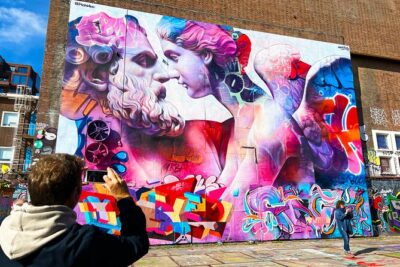
The final part of the route visits various locations connected with street art, graffiti, and houseboats. The available details do not name every stop, so you should expect a moving discussion rather than a fixed gallery visit.
This section suits you if you like seeing how people use city space outside formal institutions. Graffiti can be treated as vandalism, political speech, art, or some mixture of all three. Houseboats bring another distinct piece of Amsterdam life into view. Together, these subjects show how residents have claimed unusual forms of space and expression.
The tour’s counterculture theme comes together here. Street art and houseboats are not isolated curiosities. They sit alongside questions about who gets to use public space, which behaviors a city tolerates, and how alternative lifestyles become part of a place’s identity.
Do not expect a dedicated street-art workshop or a chance to enter private houseboats. The route is educational and observational. Its value comes from the guide’s stories and connections between the places you see.
The Red Light District is explained, not entered
This point needs to be clear before you book. Tour operators are not allowed inside the Red Light District as groups under the current rules, so this experience does not take you into the district.
The tour does cover prostitution and the district’s relevant backstory. For many people, that is enough. You can learn how the subject fits into Amsterdam’s public image without joining a large group inside a sensitive residential and working area.
If physically entering the Red Light District is your main goal, this is the wrong activity. If you want a broader discussion of Amsterdam’s approach to prostitution, the restrictions may not be a serious problem. The guide can address the subject while keeping the group on an approved route.
This is one of the tour’s more responsible features. The Red Light District is often treated as entertainment, but the area also involves residents, workers, privacy concerns, and strict rules about group behavior. A discussion-based approach may give you more useful context than a quick walk through the area.
What the $3.60 price really offers
At $3.60 per person, this is an unusually inexpensive way to spend two hours in central Amsterdam. The value is strongest if you want a basic orientation, an English-speaking guide, and a small group without paying for museum entry or transport.
The price does not cover food, drinks, transportation, or entry to the Royal Palace. That is not a problem for a walking tour, but you should understand what you are buying. The fee pays for guided interpretation, not a package of admissions and extras.
I would judge the value by the kind of questions you want answered. If you are curious about Amsterdam’s counterculture, drug policy, street art, LGBTQ history, and the gap between the city’s image and its past, the cost is easy to justify. If you want a conventional highlights tour with extensive architectural detail, you may find the experience too focused on social subjects.
The rating of 4.3 from 11 ratings suggests a generally positive response, but it is still a small sample. I would treat the score as a helpful signal, not a guarantee that every guide or group will feel identical.
Timing, group size, and practical comfort
The walk begins at 1:30 pm and lasts approximately two hours. It ends back at the National Monument, which simplifies your plans. You can continue sightseeing nearby, return to your hotel, or arrange a later meal without crossing the city to collect your belongings.
The maximum group size is 10. That is small enough for a guide to maintain contact with everyone and for you to ask questions without speaking across a crowd. It also means late arrivals create a real problem. There is no catching up with the group, so book a new time slot if you miss the start.
Confirmation arrives at booking. The meeting point is near public transportation, and service animals are allowed. Most people can participate, but remember that the experience is entirely on foot. Water and sensible footwear are more useful than any special equipment.
Free cancellation is available if you cancel at least 24 hours before the local start time. Cancellations made later are not refunded, and last-minute changes are not accepted. The tour also requires a minimum number of bookings, so a cancellation by the operator may result in another date, another experience, or a full refund.
Who should book this tour?
I would recommend this walk to adults who want Amsterdam explained through its social rules and contradictions, not just its famous buildings. It is also a good choice for a teenager accompanied by a guardian, provided the mature subjects are suitable.
You will probably enjoy it most if you like:
- Small groups and direct contact with a guide
- Street art, local neighborhoods, and unusual city stories
- Discussions about prostitution and soft drugs policy
- LGBTQ history and public memorials
- Walking rather than riding between attractions
- An inexpensive introduction before choosing more museums or paid visits
I would choose another tour if you need wheelchair-specific route information, a food component, museum entry, or a full visit inside the Red Light District. The supplied details confirm service animals are allowed and that most people can participate, but they do not provide a detailed accessibility assessment.
Should you book the Alternative Tour Amsterdam?
Book it if you want the city’s less comfortable subjects treated as part of Amsterdam’s identity. The combination of Dam Square, the Royal Palace, Jordaan, the Gay Monument, graffiti, houseboats, and discussions of prostitution and soft drugs gives you a wider picture than a standard landmark walk.
The strongest reason to go is the small group and the attempt to get behind Amsterdam’s relaxed public image. The main cautions are equally clear: it is a walking tour, the themes are mature, the Red Light District is not entered, and late arrivals cannot join after the start.
For $3.60, I see it as a strong-value orientation for curious adults. Arrive early at the National Monument, bring water, wear comfortable shoes, and expect stories about the city’s freedoms, conflicts, and compromises rather than a polished parade of postcard views.
FAQ
Where does the tour start and end?
It starts and ends at the National Monument in Dam Square, Amsterdam, postal code 1012 JS.
What time does the tour begin?
The tour starts at 1:30 pm.
How long does the experience last?
It lasts approximately two hours.
Is the tour offered in English?
Yes. An English-speaking guide leads the experience.
How many people can join the tour?
The maximum group size is 10 people.
Does the tour enter the Red Light District?
No. Tour groups are restricted from entering the Red Light District, but the tour discusses its subject matter and relevant backstory.
Can I cancel for a refund?
Yes, you can receive a full refund if you cancel at least 24 hours before the experience start time. Cancellations made less than 24 hours in advance are not refunded.
Just added around the Netherlands
- Rotterdam’s Street Art Private Walking Tour★ 5.0 · 2 reviews
- Private Highlights & Art Walking Tour: Markthal, Zadkine, Street Art and Depot★ 5.0 · 2 reviews
- Eindhoven: Self guided Individual Street Art Tour★ 4.0 · 2 reviews
- 1,5 hour private guided Mural Street Art tour in Arnhem★ 5.0 · 5 reviews
- Street Art Walking Tour, private local Dutch guide★ 5.0 · 7 reviews
- Eindhoven: Self-Guided Individual Street Art Tour★ 4.0 · 4 reviews
- Rotterdam Street Art tour: Including specialised guide★ 5.0 · 5 reviews
- Amsterdam: Urban Bike Tour, Graffiti Art & Magnet Fishing★ 5.0 · 9 reviews
Amsterdam Mural Tours, compared.

STRAAT Museum – Museum for Street Art Amsterdam Admission Ticket
Read our review →
Urban Adventures Amsterdam Bike Tour, Graffiti and Magnet Fishing
Read our review →
Amsterdam’s Hidden Gems and Street Art Bike Tour
Read our review →
Street Art Walking Tour, private local Dutch guide
Read our review →Browse the lists this tour appears in