
REVIEW · HISTORICAL TOURS
SARAJEVO STREET ART TOUR (art, history & mystery) – sARTajevo!
Sarajevo hides stories in plain sight. This small-group walk turns walls, stickers, murals, and unusual buildings into a way of reading the city, with stops that connect modern art to Sarajevo’s past. I like the personal angle: guides such as Alan, Ado, and Mak have explained works they know closely, including art created by the guide himself.
I also like the tiny group size, capped at five people, and the route’s mix of famous central streets and easy-to-miss corners. At about $30.04 for two to three hours, it offers more than a standard city stroll. The main limitation is scope: this is an introduction to Sarajevo’s street art, not a full survey of every work in town.
The tour begins at 6:00 pm at Đulagina 2 and returns there. Bring comfortable shoes and an open mind. Some pieces may appeal to you instantly; others work best once you understand the story behind them.
Five reasons this Sarajevo walk is worth your time
- The guide adds local context: Alan, Ado, and Mak have been praised for connecting artworks with Sarajevo’s past and present.
- The group is very small: A maximum of five people allows room for questions and a more personal pace.
- The route reaches overlooked art: You visit Bentbaša, Papagajka, the Academy of Fine Arts, Aria, and Ferhadija.
- The subjects go beyond painting: Expect murals, stickers, graffiti, a gallery, and architectural details.
- The tone is thoughtful rather than purely decorative: Works connected to Srebrenica and Sarajevo’s wartime memory are treated as part of the city’s story.
- The evening start is practical: At 6:00 pm, you can fit this walk around daytime sightseeing.
Why street art helps you read Sarajevo
Sarajevo is easy to approach through its mosques, churches, markets, bridges, and Austro-Hungarian buildings. Those sights matter, but they do not tell the whole story. Street art shows how people use public space to remember, protest, decorate, joke, and make a living city feel like their own.
That is the real value of this tour. You are not simply shown a painted wall and given the artist’s name. The guide explains how each work fits into Sarajevo’s artistic and social life. For someone who does not know much about art, that makes the experience accessible. You do not need to identify styles or understand art theory before you arrive.
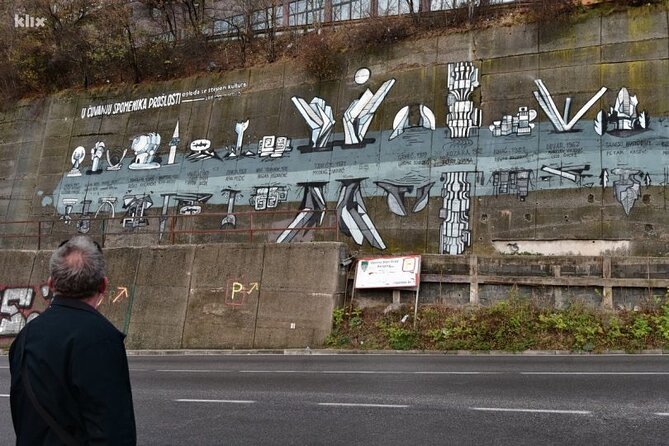
The strongest part of the walk appears to be the link between visual work and local memory. A mural about the preservation of monuments, an image connected with Srebrenica, and examples of contemporary graffiti all ask different questions about what Sarajevo chooses to keep visible.
I particularly like that the tour does not treat street art as decoration pasted onto a historic city. Instead, the art becomes another way to understand how Sarajevo has changed and how people continue to express themselves in public.
More History Tours in the world:
- 3-Hour Atlanta Beltline Food, Street Art and History Tour
★ 5.0 · 345 reviews - History and Murals: Walking Tour Guadalajara
★ 5.0 · 237 reviews - Walking Tour – Impressive murals in Historical Center of Mexico City
★ 5.0 · 224 reviews
Bentbaša and a mural about preserving the past
The first stop is Bentbaša, where you see the mural In the Preservation of Monuments of the Past. The title alone points to one of the tour’s main ideas: Sarajevo’s old buildings and newer forms of expression do not have to compete.
Your guide explains the mural in detail, giving you a useful starting point for the rest of the walk. The stop lasts about 20 minutes, and admission is free because the art is part of the public realm.
Bentbaša is a good opening location because it places you near Sarajevo’s older layers while turning your attention toward a newer artistic language. You begin to look at walls differently. A painted surface is no longer just a background or a sign of wear. It may carry a message about memory, identity, or the city’s physical survival.
The limitation here is simple: public art changes. Murals can fade, be painted over, or look different depending on light and weather. The guide’s explanation therefore matters as much as the image itself.
Papagajka, an unusual building with festival connections
The second stop takes you to Copy Papagajka, also described as the art building Papagajka, or Perrot. This location hosted Sarajevo’s first street art festival and includes examples of wall art.
The building gives the tour a stronger sense of local art history. You are not only looking at individual pieces. You are learning about the setting in which artists met, showed work, and helped form a street art scene.
The visit lasts around 20 minutes. That is enough time for an explanation and a look at the artwork without turning the tour into a long lecture. I would expect this stop to appeal to you if you enjoy places that feel connected to a city’s creative life rather than polished solely for sightseeing.
Papagajka also helps explain why a specialist guide adds value. You could pass an unusual building and notice its shape, color, or condition, but you would not automatically know about its link to the first street art festival. That sort of background is difficult to find by simply walking around with a map app.
The Academy of Fine Arts connects design and street expression
The Academy of Fine Arts is the longest stop, at about 30 minutes. Here, the tour uses examples of art to discuss Sarajevo’s past, while also visiting what is described as the city’s most beautifully designed object.
The academy gives the walk a different visual register. Bentbaša and Papagajka focus more directly on murals and wall art. This stop expands the subject to architecture, formal art education, and the way a building itself can become part of Sarajevo’s visual identity.
You also get an explanation of sticker art. That detail matters because street art is not limited to large murals. Stickers can be quick, portable, anonymous, humorous, political, or easy to miss. They show how artists claim small pieces of public space without needing a large wall or official permission.
I like the variety here. Someone who arrives thinking street art means only spray paint gets a broader picture. The one caution is that the stop combines several themes, including design, history, and stickers. If you prefer a tightly focused art walk, this may feel more like a general introduction than a specialist seminar.
A few more mural tours around the world worth a look
- Medellin: Comuna 13 Graffiti Tour, Cable Car & Street Food
★ 4.8 · 9,046 reviews - CDMX: Xochimilco, Coyoacan, Frida Kahlo Museum & Murals Tour
★ 4.4 · 3,025 reviews - Amsterdam: Streetart Museum STRAAT Entrance Ticket
★ 4.8 · 2,137 reviews - Belfast: Murals Taxi Tour
★ 4.9 · 2,047 reviews
Aria brings together Mr. Chat, the Singer, and a gallery
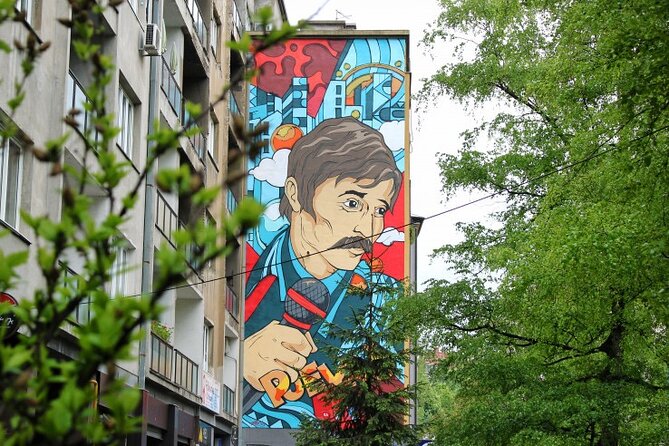
At Aria, the guide introduces several different examples: the work of Mr. Chat, the mural Singer, known locally as Pjevač, and Gallery Boris Smoje. The stop lasts about 20 minutes.
This section appears designed to show how public art can move between styles and settings. A recognizable character, a named mural, and a gallery each represent a different route into the city’s creative culture. You get a chance to compare the works rather than treating all street art as one category.
The gallery reference is useful because it broadens the experience beyond outdoor walls. Sarajevo’s creative life includes places where art is presented more formally, as well as work encountered unexpectedly on a street corner.
Your guide’s role is important here. Names such as Mr. Chat and Pjevač mean little without explanation, especially if you are new to Sarajevo’s art scene. The walk gives these works a setting and helps you notice the difference between a local reference and an international street art style.
Ferhadija and the serious weight of Srebrenica
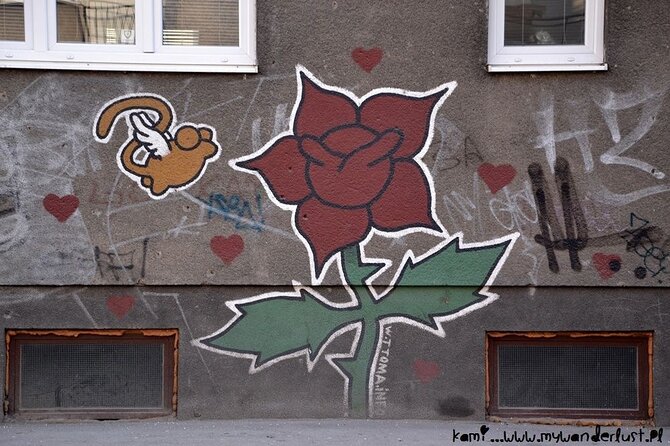
The final major stop is behind Ferhadija Pedestrian Street, where you see the mural Srebrenica 1992/1995. This is the most solemn part of the route.
A good guide needs to handle this subject with care. The tour presents the mural as part of the wider graffiti and art scene, but the dates point to the war and the genocide at Srebrenica. This is not a light photo stop. You should expect a thoughtful explanation and allow yourself time to consider what the image means in a city where public memory remains close to daily life.
The surrounding Ferhadija area also gives you a look at Sarajevo’s wider art scene. The guide introduces graffiti along the street, showing that public art can be memorial, personal, playful, or openly expressive.
This stop makes the tour more than an afternoon search for colorful walls. It explains why street art can matter in a place shaped by conflict. Art can preserve memory, claim space, and invite people to confront parts of the past that formal monuments do not always express in the same way.
The guides are the main part of the experience
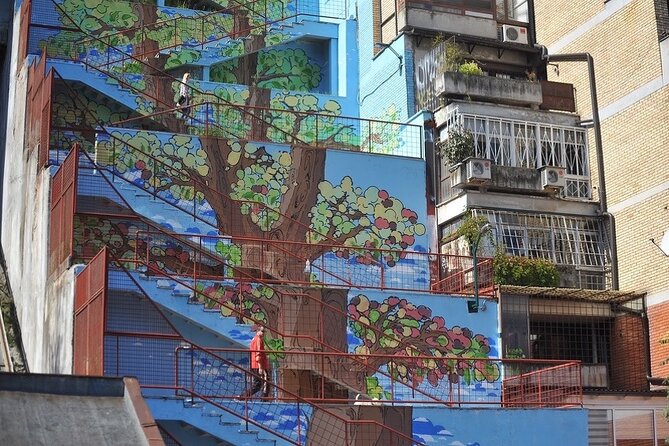
The art is the reason you book, but the guide is what determines how useful the walk becomes. Alan has been praised for explaining both his own work and the pieces along the route. Ado has been described as an excellent English speaker with a strong grasp of Sarajevo’s past and present. Mak has been praised for his friendly explanations and close familiarity with the artists and people connected to the works.
Those details suggest a personal, locally grounded experience rather than a script read at every stop. The guide may show you work that is easy to miss, explain how street art developed in Sarajevo, and point out visual details you would otherwise walk past.
I also like that the tour works for people who do not consider themselves artistic. You do not need a background in painting or design. The guide’s job is to explain what you are seeing and why it matters, not to test you.
Because the group has a maximum of five people, you should have a better chance to ask questions than on a large city walk. A small group also suits a subject that depends on stopping in front of walls, narrow streets, and small public artworks.
What the $30.04 price really buys you
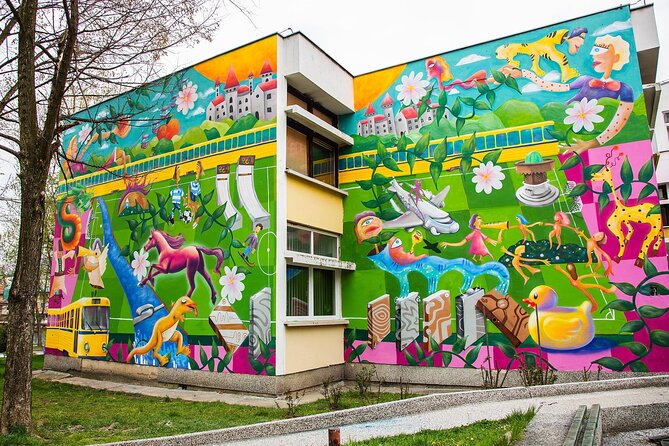
At $30.04 per person, the cost is reasonable if you want interpretation rather than simple directions. The murals and public spaces do not charge admission, so you are paying for the guide’s time, local knowledge, route planning, and ability to connect separate works into one story.
The value is strongest for a first visit to Sarajevo. You could find the main streets and perhaps locate some murals on your own, but the less obvious works would be harder to identify. Searching online might tell you what a piece is called, but it would not necessarily explain how it relates to local life or the city’s past.
The price is less compelling if you only want to photograph large murals or prefer to explore at your own pace. Some art may be brief to view, and the route is an introduction rather than an exhaustive tour of Sarajevo’s street art.
Still, the small group changes the calculation. A maximum of five gives this walk a more personal feel than a large, low-cost city circuit. If the guide is one of the strong communicators praised for the experience, the fee buys access to an informed local perspective that is difficult to reproduce alone.
Timing, walking, and practical details
The tour starts at 6:00 pm and lasts roughly two to three hours. That timing lets you use the daytime for museums, old-town sightseeing, or a separate city tour before turning to Sarajevo’s contemporary art.
The start and finish are both at Đulagina 2, Sarajevo 71000. The activity is offered in English and uses a mobile ticket. It is near public transportation, and service animals are allowed.
The route includes five main areas, with stops lasting about 20 to 30 minutes. Since the experience takes place in public streets, comfortable shoes make sense. The information provided does not specify the total walking distance, so I would not assume a short hop between every stop.
Most people can participate, but the tour is still a walking activity with repeated standing. If you need specific mobility information, ask the provider before booking rather than guessing from the stop descriptions.
You receive confirmation when you book. Free cancellation is available if you cancel at least 24 hours before the 6:00 pm start time. Changes or cancellations made later do not qualify for a refund, and the tour requires a minimum number of participants. If that minimum is not reached, you are offered another date or experience, or a full refund.
Who will enjoy this tour most
I would recommend this walk to you if you want to see Sarajevo beyond its standard landmarks. It suits people interested in public art, local culture, architecture, memory, and the way cities express themselves outside museums.
It is also a good choice if you are not an art specialist. The explanations are designed to give context, and the route includes a range of work, from murals and graffiti to stickers and gallery-related art.
History-minded visitors may find the connection between the Srebrenica mural, preservation of monuments, and Sarajevo’s wartime and postwar identity especially worthwhile. The tour does not separate art from the city’s difficult past.
You may want to skip it if you prefer grand monuments, indoor collections, or a tightly timed sightseeing route. The art scene is still described as developing, and the walk does not claim to cover every important piece in Sarajevo. The structure could also feel less sharply organized to someone expecting a formal art-history lecture.
Should you book sARTajevo?
Book this tour if you want a small, thoughtful walk that helps you notice Sarajevo’s modern creative life. The strongest reasons are the five-person limit, the personal guide commentary, the hard-to-find works, and the clear link between art and history.
I would schedule it early in your stay. Then you can recognize the city’s visual details during the rest of your visit, perhaps even finding yourself scanning walls for the blue flowers mentioned by one participant.
At $30.04, it is good value for a short introduction led by someone with local ties to the art. Just keep your expectations sensible. This is not a complete catalogue of Sarajevo street art. It is a focused walk through selected works, with enough history and personal context to make the city feel more layered.
FAQ
Where does the Sarajevo Street Art Tour begin?
The tour begins at Đulagina 2, Sarajevo 71000, Bosnia and Herzegovina.
What time does the tour start?
The scheduled start time is 6:00 pm.
How long does the tour last?
The experience lasts approximately two to three hours.
Where does the tour finish?
The tour ends back at the meeting point at Đulagina 2.
What language is offered?
The tour is offered in English.
How much does the tour cost?
The listed price is $30.04 per person.
How many people can join?
The activity has a maximum of five participants.
Which places are included?
The route includes Bentbaša, Copy Papagajka, the Academy of Fine Arts, Aria, and Ferhadija Pedestrian Street.
Are admission tickets required at the stops?
Admission tickets are listed as free for each stop.
Can I cancel for a full refund?
Yes. You can cancel at least 24 hours before the experience start time for a full refund. Cancellations made less than 24 hours before the start time are not refunded.
Just added around the world
- Your Own Belgrade: Street Art and Hidden Gems Walking Tour★ 5.0 · 2 reviews
- Vancouver: Street Art & Craft Coffee Walking Tour w/ Tasting★ 4.8 · 11 reviews
- Wynwood Walls Street Art & Neighborhood Walking Tour★ 4.9 · 9 reviews
- Xochimilco floating gardens, Coyoacan and UNAM murals★ 4.0 · 6 reviews
- UNAM: Murals & Revolution★ 4.9 · 8 reviews
- Urban Canvas: Osaka Street Art Bike Tour★ 5.0 · 10 reviews
- Vancouver: Street Art & Craft Beer Walking Tour with Tasting★ 4.8 · 14 reviews
- Small-Group Graffiti Tour and Workshop in El Carmen★ 5.0 · 2 reviews
Historical Tours, compared.

3-Hour Atlanta Beltline Food, Street Art and History Tour
Read our review →
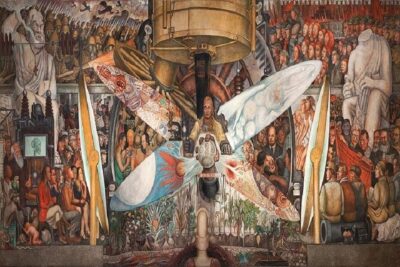
Walking Tour – Impressive murals in Historical Center of Mexico City
Read our review →
Private Political History & Murals Tour Belfast
Read our review →
2-Hour Food, History and Street Art Tour of Ponce City Market
Read our review →
Historical Shared Tour Salsa, Graffiti & Resistance in Cali
Read our review →
Street Art: The Modern History of the Northern Quarter
Read our review →
Walking Tour of Houston: History, Architecture, Street Art
Read our review →Browse the lists this tour appears in