
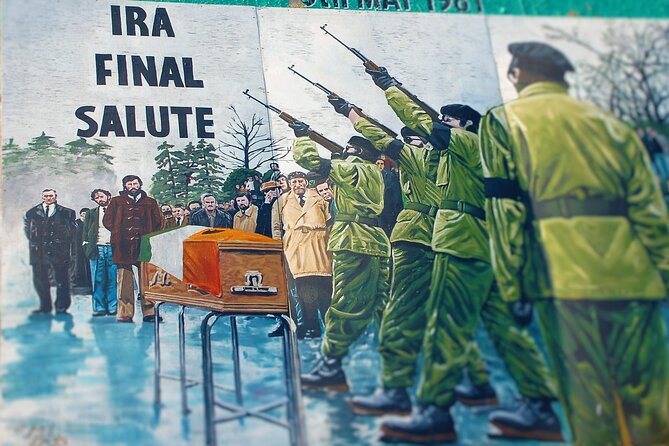
REVIEW · BELFAST MURAL TOURS
1 Hour Express Belfast Taxi/Cab Tour History, Murals, Troubles
Start with Belfast’s hardest questions. This private one-hour taxi tour links the Falls Road, Peace Wall, and Shankill Road, giving you a focused introduction to the city’s divided past and present. I like the personal format, and I like that local taxi drivers can explain what life during the Troubles meant beyond dates and headlines.
The main drawback is the short running time. You will see important places and hear plenty of context, but this is not a leisurely walking tour or a full-day history lesson. At $89.45 per person, the value depends heavily on your group size and how much you want direct conversation with a local guide.
Key points to know before booking
- A private taxi for your party: You avoid a large group and can focus on questions that matter to you.
- Three major Belfast locations in one hour: The Falls Road, Peace Wall, and Shankill Road form a clear route through the city’s political divide.
- Local insight from taxi drivers: Guides draw on local knowledge, and Brendan is specifically praised for growing up during the Troubles.
- Bobby Sands mural and Falls Road Library: These are some of the tour’s most powerful visual and historical stops.
- Hotel pickup from central Belfast: Pickup is included from most centrally located hotels, with the listed starting point at the Leonardo Hotel Belfast.
- A compact first look: This works well early in a Belfast visit, especially if you want context before exploring further on your own.
Why this one-hour Belfast tour matters
Belfast is a city where streets often carry political meaning. A mural is not simply decoration, a wall is not just a wall, and a road sign can point to a community’s identity as clearly as any museum label.
This tour gives you a quick way to read those signs. You move by air-conditioned taxi between areas associated with Irish republican and British unionist traditions, while a local driver explains the people, events, and memories tied to each place.
The private setup makes a real difference. You are not sharing the vehicle with a busload of strangers, so you can ask about a mural, pause over a difficult subject, or request clarification without feeling rushed by a crowd. The guide remains central to the experience, since the tour’s value comes less from the vehicle than from the explanation offered inside it.
The tour is offered in English and runs for about an hour. That makes it easy to fit around a museum visit, an afternoon departure, or a short stay in Belfast. It also means you need to accept a brisk pace. This is an introduction, not an exhaustive account of Northern Ireland’s past.
More Political Mural Tours in Belfast:
- Belfast’s Political Mural Taxi Tour
★ 5.0 · 1,180 reviews - Belfast: Private Black Taxi Cab Political Murals Tour
★ 4.9 · 425 reviews - Political Wall Murals and Peacewall
★ 4.9 · 247 reviews
Falls Road, Bobby Sands, and the first layer of the story
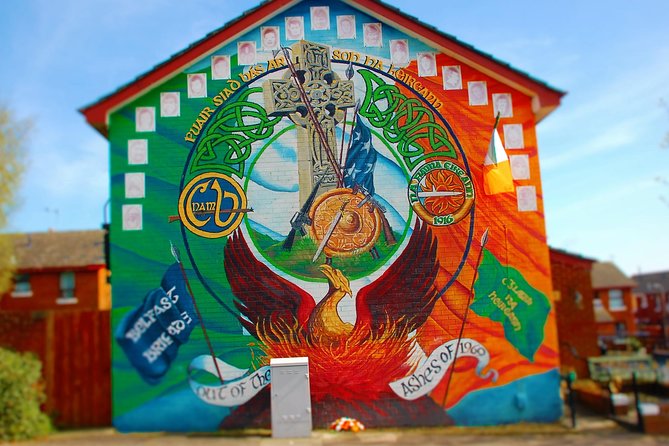
The Falls Road is the tour’s main republican setting. It is a predominantly Catholic and nationalist part of Belfast, long associated with Irish republican politics and culture. During the Troubles, the area became closely linked with the Provisional Irish Republican Army, formed in 1969 after a split within the Irish Republican Army.
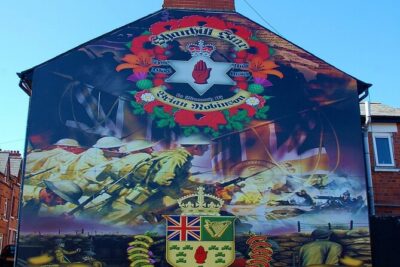
Your guide places the murals within that setting rather than treating them as isolated street art. That context matters. The images reflect political beliefs, community memory, and the conflict between those who supported Irish unity and those who wanted Northern Ireland to remain part of the United Kingdom.
One of the most notable sights is the Falls Road Library. Its walls still show bullet holes from gun battles involving British Army forces. That detail can be easy to miss from a passing car, so listen closely when the taxi stops or slows near the site. The building gives the conflict a physical scale: this was not only a political argument carried out in speeches, but a period when ordinary buildings could become part of armed confrontation.
Across from the library is the Bobby Sands mural, located on the side of Sinn Féin’s Belfast headquarters. Sands was an IRA member who died on hunger strike in 1981 while imprisoned in the H Block prison. His death made him a major symbol for the republican cause.
The mural includes his portrait and the line Our revenge will be the laughter of our children. That message shifts the tone from armed struggle toward a hoped-for future. You do not need to share Sands’ politics to understand why the mural remains so important. It shows how public art can preserve grief, identity, and political purpose in a single image.
I would give this stop your full attention. The mural is visually striking, but the surrounding explanation is what makes it useful. Ask your guide how the area changed during the Troubles, how the murals function today, and how local communities remember the period. The one-hour limit means you may not have time for a long conversation, but even a few direct questions can make the images easier to understand.
Divis and the republican side of Belfast
The tour allows about 25 minutes for Divis and the Falls Road area. That is the largest single portion of the route, and it makes sense. This is where the political murals, community history, and memories of the Troubles come together most clearly.
Divis is part of West Belfast, an area shaped by nationalist sentiment, social deprivation, and sectarian division. The nearby Shankill Road became associated with a predominantly Protestant and loyalist community, creating a sharp boundary between neighborhoods with different political aims and cultural identities.
The key benefit of visiting by taxi is that you can cover more ground than on foot in a short period. The driver can point out locations connected with the conflict while keeping the route moving. You will not spend the hour walking from one mural to the next, which is useful if you want an overview rather than a slow street-by-street study.
Still, this section can feel dense. You may see several murals and hear names, organizations, and events in quick succession. I recommend keeping your questions simple and asking the guide to explain the details that interest you most. The private format helps here, since your group can set the tone.
This part of Belfast is best approached with respect. The murals are tied to real loss and lasting political views. Some images celebrate people and causes that remain deeply divisive. A good guide can explain the republican perspective without asking you to adopt it, and can help you understand why these symbols remain in public view.
The Peace Wall and the meaning of signing your name
The Peace Wall is the tour’s clearest physical symbol. These barriers were first erected in 1969, during the early years of the Troubles, to separate predominantly Catholic and nationalist communities from predominantly Protestant and unionist communities.
They were intended as temporary measures to reduce violence. Instead, many remained and expanded over the decades. The barriers range from shorter fences to large concrete structures topped with steel, barbed wire, or gates.
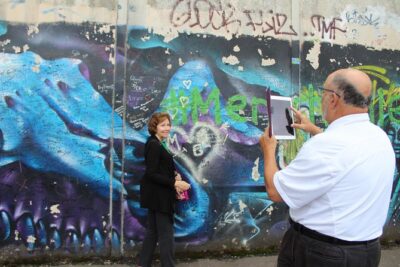
The tour allows about 10 minutes here. That is enough to see the wall, take in its scale, and sign your name. The chance to add your name gives the stop a small personal element, but it should not distract from what the wall represents. It is a reminder that Belfast’s peace was built alongside physical separation, not simply by removing it.
You may find this the most thought-provoking part of the hour because the wall is both practical and unsettling. It helped reduce violence, yet its continued presence shows how difficult trust and integration can be after years of conflict.
Do not expect a long visit or a formal museum presentation. The value comes from your guide’s explanation and your own reaction to the barrier. If you want detailed information about every wall in Belfast, this tour will feel too brief. If you want to understand why the city still has visible divisions, 10 focused minutes can be enough to leave an impression.
More Mural Tours by Tuk-Tuk and Taxi in Belfast:
- Belfast: Murals Taxi Tour
★ 4.9 · 2,047 reviews - Belfast Murals Taxi Tour
★ 5.0 · 341 reviews - 2 Hour Private Belfast Taxi Cab Tour of Troubles & Peace walls
★ 5.0 · 240 reviews - Black Taxi Mural “Tour Like A Local”
★ 5.0 · 125 reviews
Shankill Road and the loyalist perspective
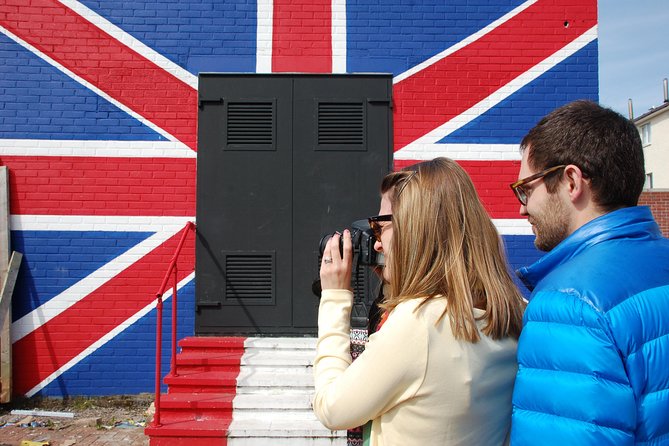
The final major section takes you to Shankill Road, a predominantly working-class, Protestant, unionist, and loyalist area. The road is associated with political murals and with loyalist paramilitary organizations including the Ulster Volunteer Force and the Ulster Freedom Fighters.
This stop matters because it keeps the tour from presenting Belfast through only one community’s experience. After hearing about Falls Road and republican murals, you see a setting shaped by a different political tradition and a different understanding of British identity.
The tour allows about 25 minutes here. That gives your driver time to explain the murals and the area’s role during the Troubles. As on Falls Road, the artwork is political. It reflects community identity, loyalty, remembrance, and the armed groups connected with the conflict.
I appreciate the balance of the route. You are not asked to treat one neighborhood as the whole story. Instead, you move between two communities and then see the barrier that once, and in some places still does, separate them.
The subject can be uncomfortable, and that is appropriate. A tour of Belfast’s murals should not turn painful history into a colorful photo stop with no explanation. Keep your camera use considerate, listen to the guide, and remember that these are living communities rather than an open-air theme park.
What the local taxi guide adds
The strongest reason to book this experience is the guide. A local taxi driver can connect political events with the daily reality of growing up in Belfast during the Troubles.
Brendan is specifically praised for having grown up as a child during that period and for explaining what happened with unusual personal insight. That does not mean you are guaranteed Brendan on your departure, but it gives you a useful sense of the kind of perspective this tour aims to offer.
A guide with local experience can explain why the Falls Road and Shankill Road remain emotionally important, why certain murals are still maintained, and how the Peace Wall fits into modern Belfast. You may also get a clearer sense of how public memory differs between communities.
The best approach is to treat the driver as a storyteller and interpreter, not simply as someone moving you between photo stops. Ask questions about the meaning of what you see. The private format gives you room to do that.
Is $89.45 per person a fair price?
At $89.45 per person, this is not the cheapest way to see Belfast’s political murals. The price makes more sense for a small group that values privacy, a dedicated vehicle, and direct access to a local guide.
You are paying for the private arrangement rather than admission tickets. The listed stops have no admission charge, and the experience includes an air-conditioned vehicle and guide. Pickup from most central Belfast hotels is also included, with the advertised meeting point at the Leonardo Hotel Belfast on Great Victoria Street.
For two people, the total cost is significant for one hour. For a larger private party, the per-person value may improve because you are sharing the vehicle with your own group. You also save time compared with walking between the three areas.
I would choose this tour if I wanted a compact introduction and personal discussion. I would hesitate if I wanted a low-cost sightseeing option or a longer historical tour with time for museums and extended stops.
Who should book this Belfast taxi tour?
This experience suits you if you have only a short time in Belfast, want to understand the Troubles before exploring alone, or prefer a private setting for serious history.
It is also useful for visitors who find political history easier to follow when a local person explains it at street level. Families can take part, but children must be accompanied by an adult, and the subject matter may require some preparation for younger children.
You should know that this is not a food tour, a pub tour, or a general city sightseeing trip. The focus is firmly on murals, political identity, the Troubles, and the communities connected with Falls Road, the Peace Wall, and Shankill Road.
The tour is near public transportation, and most people can participate. Since the experience is private, you do not need to adjust your questions or pace to a larger shared group.
Practical details before you reserve
Confirmation is provided at the time of booking. The tour begins at the Leonardo Hotel Belfast, and the activity ends back at the meeting point. Pickup is available from most centrally located Belfast hotels, so check your hotel location when making arrangements.
The experience is non-refundable and cannot be changed after booking. If the minimum number required for the tour is not met, the operator will offer another date or experience, or provide a full refund.
Because the tour lasts only about an hour, arrive ready to listen from the start. Keep your questions in mind before the taxi leaves, and pay attention during the Falls Road section, where much of the historical context is introduced.
Should you book it?
Book this tour if you want a direct, local explanation of Belfast’s divided communities in a private vehicle and have limited time. The combination of Falls Road, Bobby Sands, the Peace Wall, and Shankill Road gives you a clear framework for understanding the city.
Skip it if you want a long, slow visit, a budget option, or a broader tour of Belfast’s museums and landmarks. At $89.45 per person, the price is easiest to justify when personal guiding matters to you.
For many first visits, I would place this tour early in the Belfast schedule. Once you understand what the murals and walls represent, the rest of the city becomes easier to read.
FAQ
How long does the Belfast taxi tour last?
The tour lasts approximately one hour.
Is the tour private?
Yes. Only your group participates in the activity.
Where does the tour start?
The listed starting point is the Leonardo Hotel Belfast on Great Victoria Street, Belfast BT1 6DY.
Where does the tour end?
The activity ends back at the meeting point.
What locations are included?
The route includes the Falls Road and Divis area, the Peace Wall, and Shankill Road.
Is hotel pickup available?
Pickup is included from most centrally located Belfast hotels.
What language is the tour offered in?
The tour is offered in English.
What is included in the price?
The experience includes a guide and an air-conditioned vehicle. Food, drinks, and other beverages are not included.
More One-Hour Experiences in Belfast
- Wynwood Art District 1-Hour Street Art Tour by Golf Cart
★ 4.9 · 492 reviews - Wynwood Art District 1-Hour Wynwood Buggies Street Art Tour
★ 4.9 · 289 reviews
More History Tours in Belfast
- Private Political History & Murals Tour Belfast
★ 5.0 · 182 reviews - Belfast political history and mural unique private 90 min tour
★ 5.0 · 10 reviews - 2 Hour Terror and Mural History Belfast taxi Private Tour
★ 5.0 · 7 reviews - Belfast history of terror & mural 1 hr express private taxi tour
★ 5.0 · 3 reviews
Just added around Belfast
- Falls road Murals Walking Tour with former prisoners★ 5.0 · 19 reviews
- 2 Hours Republican & Loyalist Mural Black Taxi Tour from Belfast★ 5.0 · 21 reviews
- World Famous Private Belfast Troubles Taxi Cab Tour 2 Hour★ 4.5 · 14 reviews
- Belfast history of terror & mural 1 hr express private taxi tour★ 5.0 · 3 reviews
- Private Belfast Mural & Giant’s Causeway Tour from Belfast (2 in 1)★ 5.0 · 5 reviews
- Belfast political history and mural unique private 90 min tour★ 5.0 · 10 reviews
- Best of Belfast Driving Taxi Tour with Political Murals★ 5.0 · 9 reviews
- Belfast Cab Tour of Peacewalls, Murals and the Famous Titanic Slips★ 5.0 · 4 reviews
Belfast Mural Tours, compared.
2 Hour Private Belfast Taxi Cab Tour of Troubles & Peace walls
Read our review →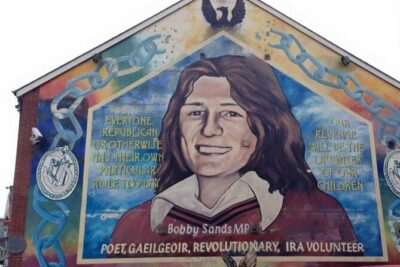
Private Political History & Murals Tour Belfast
Read our review →Browse the lists this tour appears in