
REVIEW · DENMARK MURAL TOURS
Street Art and Rooftops of Aarhus, Denmark
Aarhus reveals itself through art. This two-hour walking tour links the waterfront, Latin Quarter, creative rooftops, former industrial spaces, City Hall, and a high viewpoint into one lively introduction to Denmark’s second city. I especially like the mix of street art and local history, plus the small maximum of 10 people, which leaves room for questions and conversation.
I also like that the art is not treated as decoration alone. Your guide explains how works came to be, what artists may be saying, and how public art connects with the community. The main consideration is the walking: you need moderate physical fitness, and the tour is not entirely outdoors, so the exact indoor portions and route may vary.
Key points to know before booking
- A two-hour art walk with a broad city view: The route moves from the seaside to the Latin Quarter, creative quarters, the City Hall area, and back toward the harbour.
- Small groups make a difference: The tour accepts no more than 10 people, giving you a better chance to ask about artists, buildings, and local customs.
- Marina earns especially warm praise: Her tours are valued for lively stories, artistic insight, and affectionate knowledge of Aarhus.
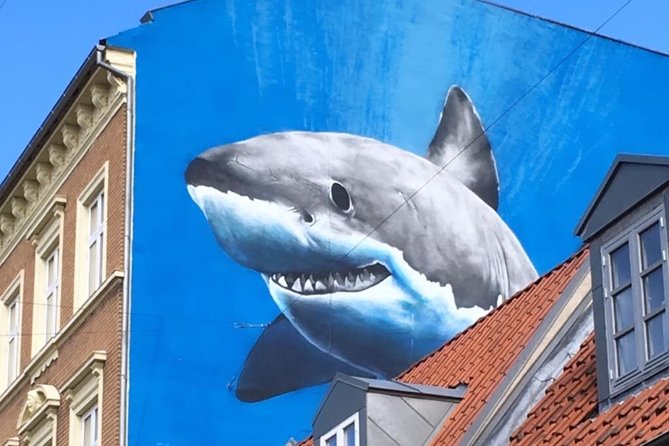
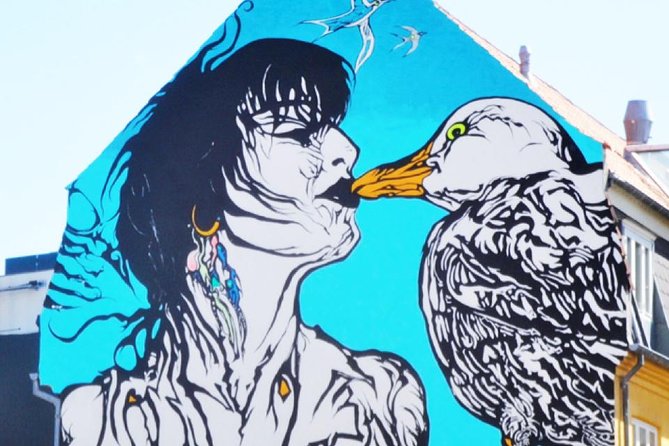
- Expect several kinds of public art: You may see sculptures, graffiti, murals, installations, and architectural details.
- The final viewpoint is a highlight: A viewpoint opened in 2017 provides a memorable finish high above the city.
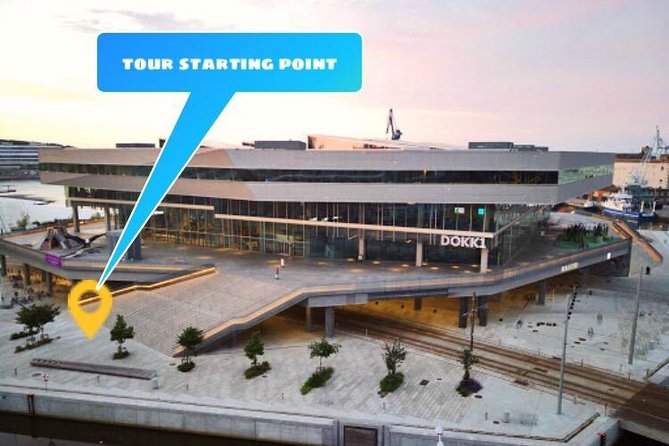
- Check the meeting pin carefully: The information gives Dokk1 at Hack Kampmanns Plads 2 as the starting point, while the meeting-point details list Europaplads 3.
Why this Aarhus tour works so well
Aarhus is compact enough to explore on foot, but it can be hard to understand at street level during a short visit. A church, mural, sculpture, converted warehouse, and modern public building can all sit within a few minutes of one another, yet their connections are easy to miss.
This tour gives you a theme that ties those pieces together. Instead of simply ticking off monuments, you look at the city through the people who make, fund, display, and live with art in public places. That approach suits you if you prefer local stories to a long list of dates.
I also appreciate the balance between planned sights and small details. The walk includes known parts of central Aarhus, but it also draws attention to art and corners you might pass without noticing. One participant who had lived near Aarhus for two years still found plenty that had escaped notice. That is a useful clue: this is not only for first-time visitors.
The tour is conducted in English, though the guide may be multilingual. The tone seems to be conversational rather than formal. Marina is repeatedly praised for her enthusiasm, humor, artistic background, and ability to explain both the work and the city around it.
A few more mural tours around the world worth a look
- Medellin: Comuna 13 Graffiti Tour, Cable Car & Street Food
★ 4.8 · 9,046 reviews - CDMX: Xochimilco, Coyoacan, Frida Kahlo Museum & Murals Tour
★ 4.4 · 3,025 reviews - Amsterdam: Streetart Museum STRAAT Entrance Ticket
★ 4.8 · 2,137 reviews
From the waterfront to the old houses of the Latin Quarter
The route begins near the waterfront and heads toward Aarhus’s Latin Quarter, an old central district known for charming houses. Starting beside the sea gives the walk a useful sense of place. You begin with the city’s relationship to the harbour before moving into older streets and smaller-scale buildings.
The change in surroundings is part of the lesson. At the waterfront, you encounter Aarhus as a modern, open city. In the Latin Quarter, the atmosphere becomes more intimate, with older facades and narrow streets. This contrast helps you see that Aarhus is not one single architectural idea. It mixes historic residential streets with contemporary cultural projects.
Here, the guide’s commentary matters more than the route alone. You can ask about buildings, local life, and the way public art fits among older homes. Marina is particularly praised for adding amusing facts and unusual stories alongside the standard city information.
Do not expect a museum-style lecture at every stop. The pleasure is in walking, looking up, and making connections between what you see. If you enjoy taking photographs, you will likely find plenty of changing backgrounds, from old houses to painted walls and public sculptures.
Street art with a story behind it
The art is not limited to one style. The walk includes murals, graffiti, sculptures, and installations, with each work offering a different way to read the city.
That variety keeps the tour from becoming repetitive. A large mural asks different questions from a small sculpture. Graffiti may reflect a faster, less formal part of urban culture, while an installation may have a clear public or civic purpose. Your guide helps you notice details, styles, and possible messages that are easy to miss when you walk past on your own.
This is where Marina receives the strongest praise. She is described as passionate about art and able to explain artists’ intentions, visual styles, and the stories behind the works. She also points out newly finished murals, so the route is not simply built around old, fixed sights.
Public art can change. A wall may be repainted, an installation may be moved, and a new work may appear. That gives this kind of tour a more immediate quality than a standard monument walk. You are looking at a city that is still being made.
I would book this experience if you like asking why something is there, who paid for it, how local people responded, or how an artist chose a certain shape or color. If you only want a quick list of the most famous sights, a conventional city tour may suit you better.
A rooftop stop in Aarhus’s creative quarter
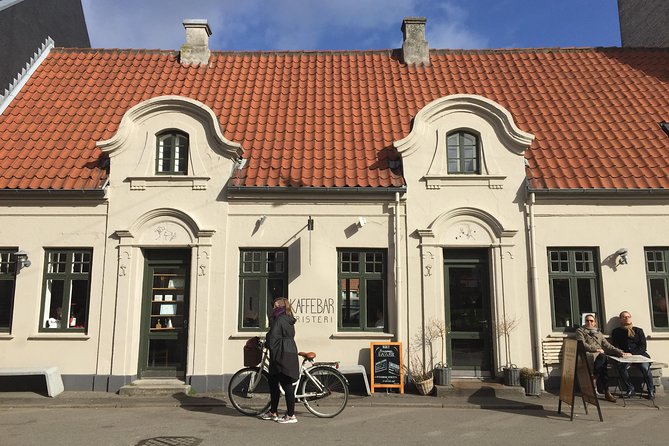
The route continues to a hip hangout used by freelancers and other creative people. The tour includes time on a rooftop where people gather for coffee, giving you a look at a more current side of Aarhus.
This stop adds a welcome pause to the walking. It is not just another street corner. You get a sense of how creative work and casual public life overlap in the city. The rooftop setting also shifts your view from facades and pavement to the wider surroundings.
The supplied details do not promise that food or drinks are included. They are specifically not included in the price, so you should plan to pay for anything you choose to buy. The tour price covers the professional guide, not refreshments.
That distinction is worth noting because the stop sounds relaxed and social. You can enjoy the setting without assuming it is a meal break. The tour lasts about two hours, so the main focus remains the walk and commentary.
Same walls, a different guide:
- Belfast: Murals Taxi Tour
★ 4.9 · 2,047 reviews - Wynwood Graffiti Golf Cart Small-Group Tour
★ 5.0 · 1,646 reviews - London: Street Art and Graffiti Guided Walking Tour
★ 4.9 · 1,354 reviews - Lisbon: Street Art Tour
★ 4.9 · 1,324 reviews
From old industry to a modern art space
One of the most interesting changes along the route is the move into a former industrial site that has been converted into a modern art space. This is a strong example of how Aarhus reuses older working areas for culture.
The value here is not only the art inside. The building itself tells part of the story. Industrial places often have a different scale and texture from the old houses in the Latin Quarter, and their new use shows how a city can adapt without erasing every trace of its past.
You do not need to buy an entry ticket for the attractions visited on the tour. That keeps the price easier to understand. You are paying mainly for the guide’s time, interpretation, and route planning rather than adding admission fees at each stop.
The information does not say that every room or exhibition is visited in detail, so I would treat this as one part of a broader city walk, not a full museum visit. The tour uses the site to explain Aarhus’s art scene and urban change.
City Hall, monuments, and the official centre
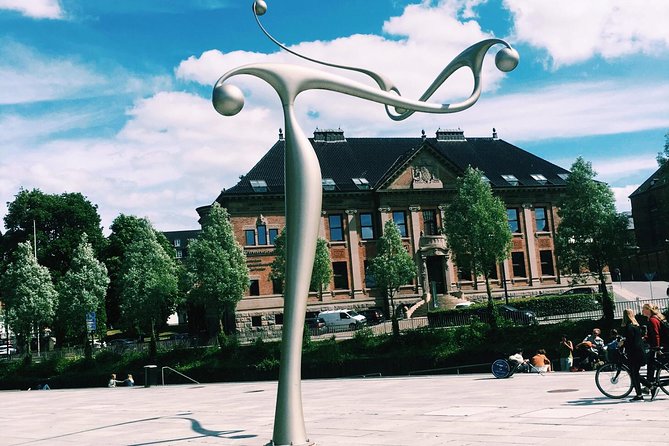
From the art space, the route heads toward the official city centre and the monuments around City Hall. This section broadens the tour beyond street art.
That is important because the art does not exist separately from civic life. Public monuments, government buildings, streets, and gathering places all shape how people experience a city. The guide’s job here is to connect the formal centre with the less official art seen earlier.
You can expect commentary on the monuments and nearby buildings, along with stories about Aarhus. The strongest praise for Marina is not limited to her art knowledge. She is also valued for explaining architecture, local history, city life, and the quirks of individual places.
This part may appeal most if you want a city overview as well as an art walk. One visitor described the pace as comfortable and the route as a useful general introduction to Aarhus. That makes the tour a smart choice near the beginning of a stay, when you can use the information to decide what to revisit later.
The high viewpoint that closes the route
The walk returns toward the harbour and reaches a viewpoint opened in 2017. It has already drawn millions of visitors, according to the tour information, and the final view is presented as a major reward.
The exact experience will depend on weather and visibility, but the purpose is clear: you finish above the city rather than at street level. After seeing murals, old homes, industrial buildings, and civic monuments from close range, you get a wider picture of Aarhus.
The viewpoint also gives the route a satisfying shape. You start by the water, move through several layers of the city, and end with a broad look back across it. One Danish-language review singled out the finish high above the city as especially enjoyable.
Because this is the final major sight, I would save a little energy for it. The walk is not described as strenuous, but it does require a moderate level of fitness. Comfortable shoes are a sensible choice, though the supplied information does not give a precise distance or a detailed accessibility statement.
What the $63.20 price gives you
At $63.20 per person, this is not the cheapest way to spend two hours in Aarhus. The value depends on how much you want from a guide-led experience.
The price includes a professional guide and access to the route’s attractions without separate entry tickets. For me, the strongest value is the interpretation. Anyone can walk through central Aarhus, but a good guide can show you what to look at, explain why it matters, and make the city easier to read.
The maximum group size of 10 also supports the price. A small group allows more direct conversation than a large walking tour. You can ask about an artist, stop to examine a detail, or request a little more context without shouting across a crowd.
The cost is harder to justify if you mainly want to see murals quickly or if you plan to explore entirely on your own. It becomes more reasonable if you care about public art, want a personal introduction to Aarhus, and value access to a guide with strong artistic knowledge.
Food and drinks are not included. There are no entry tickets required for the attractions visited, but you should still budget separately for refreshments if you want them.
Timing, meeting point, and practical concerns
The advertised start time is 10:00 in the morning, with a duration of about two hours. A morning start leaves much of the day free for museums, shopping, or independent exploring.
There is one practical detail you should confirm before setting out. The route description names Dokk1, the city multimedia centre at Hack Kampmanns Plads 2, as the starting point. The meeting-point information lists Europaplads 3, 8000 Aarhus, as the start and says the tour ends back at the meeting point.
Because those locations are presented differently, check the exact meeting instructions after booking. The confirmation should arrive at booking time, and checking the map pin before the morning of the tour can prevent a rushed start.
The tour is offered in English, although a multilingual guide may lead it. It is capped at 10 people. Cruise ship passengers must provide the ship name, docking time, disembarkation time, and re-boarding time when booking. That information helps the operator judge whether the schedule fits your port visit.
You can cancel for a full refund if you do so at least 24 hours before the start time. Changes or cancellations inside that window are not accepted for a refund.
Who should book this walk
I would recommend it most strongly to art lovers, curious first-time visitors, and people who prefer stories to silent sightseeing. It also suits anyone who has already seen Aarhus’s central streets but wants a better sense of its public art and creative life.
The tour can work well for people who live nearby, too. The route includes details that are easy to overlook, and the guide’s stories may change how you see familiar streets.
Families and mixed-interest groups may also find the variety useful, though the information does not specify a children’s format. Anyone with limited walking ability should think carefully, since moderate physical fitness is required and the full accessibility arrangements are not provided.
The small group is a major plus for solo visitors and couples who want conversation. It is also useful if you have a particular interest in architecture, murals, sculpture, or Danish city culture and want to ask questions along the way.
Should you book Street Art and Rooftops of Aarhus?
Book it if you want Aarhus explained through its art, buildings, and local stories, not just photographed from the pavement. The mix of old houses, creative spaces, public monuments, industrial reuse, and a high viewpoint gives you a well-rounded introduction in about two hours.
I would be more cautious if you dislike walking, need a fully outdoor route, or want a long museum visit with guaranteed indoor exhibition time. The price is fair for a small group and a strong guide, but it is not aimed at the do-it-yourself budget explorer.
For most art-focused visitors, the combination of Marina’s personal storytelling, the 10-person limit, and the variety of sights makes this a worthwhile way to get your bearings in Aarhus.
FAQ
How long does the Street Art and Rooftops of Aarhus tour last?
The tour lasts approximately two hours.
What time does the tour start?
The scheduled start time is 10:00 am.
Is the tour offered in English?
Yes. The tour is offered in English, though it may be operated by a multilingual guide.
How many people can join the tour?
The tour has a maximum of 10 travelers.
Where does the tour start?
The route information names Dokk1 at Hack Kampmanns Plads 2 as the starting point. The meeting-point details list Europaplads 3, 8000 Aarhus, so you should check the exact confirmation and map pin before arrival.
Where does the tour end?
The activity ends back at the meeting point.
Are attraction entry tickets included?
No entry tickets are required for the attractions visited on the tour.
Are food and drinks included?
No. Food and drinks are not included in the price.
Can I cancel for a full refund?
Yes. You can receive a full refund by cancelling at least 24 hours before the experience start time. Cancellations or changes made less than 24 hours before the start are not accepted for a refund.
Just added around the world
- Your Own Belgrade: Street Art and Hidden Gems Walking Tour★ 5.0 · 2 reviews
- Vancouver: Street Art & Craft Coffee Walking Tour w/ Tasting★ 4.8 · 11 reviews
- Wynwood Walls Street Art & Neighborhood Walking Tour★ 4.9 · 9 reviews
- Xochimilco floating gardens, Coyoacan and UNAM murals★ 4.0 · 6 reviews
- UNAM: Murals & Revolution★ 4.9 · 8 reviews
- Urban Canvas: Osaka Street Art Bike Tour★ 5.0 · 10 reviews
- Vancouver: Street Art & Craft Beer Walking Tour with Tasting★ 4.8 · 14 reviews
- Street Art Tour in Vienna★ 4.0 · 17 reviews
Denmark Mural Tours, compared.

MACA Museum ‘Banksy & Street Art: The Early Years’ Art Exhibition
Read our review →

Small Group Guided Food Tour and Street Art Visit to Norrebro
Read our review →Browse the lists this tour appears in